Cell4Pharma is a Contract Research Organization (CRO), offering state-of-the-art nephrotoxicity screening assays and vesicular transport assays to the pharmaceutical and biotech industries.
Cell4Pharma has developed innovative vesicle-based assays that enable precise studies of cell communication, drug delivery and membrane dynamics. These assays improve the accuracy and efficiency of early-stage research, supporting drug development and the understanding of cellular processes.
Human drug efflux transporters (ABC transporters) are transiently overexpressed in human embryonic kidney (HEK293) cells. Inside-out membrane vesicles are prepared from these HEK293 cells and used for high-throughput applications. The transporters translocate substrates into membrane vesicles in an ATP-dependent manner. Detection of the substrate inside the vesicles is possible with radiolabel, fluorescence, or LC-MS detection. Cell4Pharma delivers high quality large uniform batches with guaranteed transport ratios. Each vesicle kit contains the following materials for 100 reactions:

Kits can be used for substrate identification or inhibition screening. A master mix will be prepared, added to the membrane vesicles and incubated at 37℃ in the presence of ATP or AMP. Loaded vesicles will be filtered, lysed and eluted for detection.
| Product Name | Catalog No. |
| Human BCRP vesicle kit (HEK293 derived) | C4PVK006 |
| Human BSEP vesicle kit (HEK293 derived) | C4PVK007 |
| Human MRP1 vesicle kit (HEK293 derived) | C4PVK001 |
| Human MRP2 vesicle kit (HEK293 derived) | C4PVK002 |
| Human MRP3 vesicle kit (HEK293 derived) | C4PVK003 |
| Human MRP4 vesicle kit (HEK293 derived) | C4PVK004 |
| Human MRP5 vesicle kit (HEK293 derived) | C4PVK005 |
| Human MRP8 vesicle kit (HEK293 derived) | C4PVK008 |
| Human Pgp vesicle kit (HEK293 derived) | C4PVK010 |
| Human Pgp vesicle kit (HEK293 derived) with FluoPgp substrate | C4PVK011 |
| Human Control vesicle kit (HEK293 derived) | C4PVK009 |
Our nephrotoxicity assays, based on our patented ciPTEC human renal model, provide precise and reliable safety assessment of drug candidates, delivering comprehensive data to strengthen your drug development process. With personalised solutions, we cater to the unique needs of your projects at any stage of development.

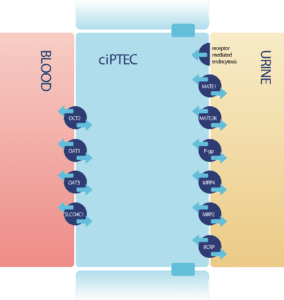
Renal proximal tubular epithelial cells (PTECs) are responsible for the reabsorption of filtered solutes by glomerulus and the excretion of waste products and xenobiotics and their metabolites. PTECs are prone to drug-induced toxicity because they express various transmembrane drug transporters, which facilitate the basolateral influx (organic anion transporter 1 and 3(OAT-1) and organic cation transporter 2 (OCT2)) and the apical efflux (P-glycoprotein transporter (P-gp), multidrug resistance protein 4 (MRP4), breast cancer resistance protein (BCRP), and multidrug and toxin compound extrusion-1 (MATE1)) of a potentially toxic compound.
Acute kidney injury (AKI) is characterized by a rapid decline of the kidney function. Drug-induced toxicity (i.e., nephrotoxicity) can explain 14-16 % of adult AKI cases and 16 % of pediatric AKI cases. In severe cases, AKI can progress to chronic kidney disease and eventually to end-stage kidney disease. The latter being treated with renal replacement therapy: dialysis or transplantation. This underscores the unmet need to better understand the mechanism of drug-induced nephrotoxicity and prevent drug-induced renal toxicity for compounds yet under development.
Clinically relevant drug-drug interactions (DDIs) belong to adverse effects associated with concomitant drug treatment modalities. DDIs may have significant harmful effects for a patient. Generally, metabolism of DDI’s in the liver may impact drug efficacy and renal elimination. Within this, DDIs can lead to decreased metabolism of either or both drugs resulting in elevated plasma drug levels or increased metabolism of either or both drugs causing reduced efficacy, formation of a toxic metabolite, or reduced drug transporter influx and efflux. For example, DDI at the site of the renal drug transporter may cause toxic events, i.e., when a compound is accumulating in the proximal tubule cells. Therefore, it is important to evaluate DDI of an investigational new drug. The FDA and the EMEA recommend assessment of potential DDIs in vitro as this highlights the impact of multiple clearance pathways as well as lead to better candidate compounds entering clinical studies.
Cell4Pharma is specialized in in vitro cell-based nephrotoxicity assays to identify potential renal toxic compounds at an early stage of drug discovery. conditionally immortalized renal proximal tubule epithelial cells (ciPTEC) are being utilized for nephrotoxicity assays we provide and these cells show proximal tubule characteristics and express functional influx and efflux drug transporters (OAT1, OCT2, P-gp, MRP4, BCRP). The aforementioned reasons and more than 90 publications support the fact that our ciPTECs are highly stable and present an accurate model to assess nephrotoxicity in vitro.
Cell4Pharma has developed a unique conditionally immortalised human proximal tubule epitelial cell line (ciPTEC) expressing most relevant renal drug transporters endogenously. Our cells are protected under patent PCT/EP2010/066792. To improve the plethora of stable drug transporter functionality in ciPTEC, our product portfolio was extended with ciPTEC-OAT1 and ciPTEC-OAT3 with a market introduction in 2017. As such, Cell4Pharma’s ciPTEC platforms provide an excellent tool to predict pharmaco-kinetics, drug interactions and renal toxicity for potential pharmaceutical compounds.
The recent guidances for the pharmaceutical industry published by the Food and Drug Administration (FDA) in 2017 and the European Medicines Agency (EMA) in 2013 recommend that drug development should include identification of elimination routes via drug transport proteins and characterize drug-drug interactions (DDI). These include the investigation of renal drug transport studies at the sites of p-glycoprotein (Pgp), breast cancer resistance protein (BCRP), multidrug and toxin extrusion transport 1 and 2 (MATE1, MATE2-k), organic cation transporter 2 (OCT2) and organic anion transporter 1 and 3 (OAT1, OAT3). All transporters are present in our ciPTEC platforms.
Our Cell Viability Assay, utilizing the WST-8 reagent, employs conditionally immortalized proximal tubule epithelial cells (ciPTECs) for a nuanced evaluation of test compounds. This assay exposes ciPTECs to a 9-point concentration curve in triplicates, generating crucial concentration data for subsequent assays. While traditional cell viability assessments distinguish between living and dead cells, they may miss subtle nephrotoxic effects. Our service transcends these limitations, offering an advanced approach for a comprehensive understanding of renal cellular responses. Explore our follow-up assays (see below) for a detailed and accurate nephrotoxicity assessment.
LDH cytotoxicity assay, featuring conditionally immortalized proximal tubule epithelial cells (ciPTECs), provides an advanced platform for assessing the impact of test compounds on renal cells. In this process, ciPTECs are exposed to a carefully determined optimal concentration of the test compound, as identified in the viability assay, and the trials are conducted in duplicates. The subsequent quantification of lactate dehydrogenase (LDH) release serves as a reliable indicator of cytotoxic effects. This assay ensures a quantitative and comprehensive analysis of nephrotoxicity, allowing for precise measurement of cell damage.
For an oxidative stress assay in ciPTECs, we employ the CM-H2DCFDA probe, a cell-permeable indicator that reacts with intracellular reactive oxygen species (ROS). This reaction induces a fluorescent signal, allowing precise measurement of ROS levels in response to test compounds. Crucial for revealing oxidative stress-induced nephrotoxicity, a critical parameter in drug safety assessment, this assay provides a comprehensive analysis. By evaluating ROS levels, we gain insights into the potential impact of compounds on renal cells, ensuring a thorough understanding of their safety profile in the context of renal health.
N-Acetyl-β-D-Glucosaminidase (NAG) analysis in ciPTECs offers a focused approach to nephrotoxicity assessment. NAG, predominantly located in the lysosomes of proximal tubular cells, is a biomarker and elevated levels of NAG in response to a test compound serve as indicative signs of proximal tubular damage. Through this biomarker analysis, we provide valuable insights into renal health, aiding in the identification of potential nephrotoxic effects and contributing to a comprehensive evaluation of compound safety in the context of renal function.
Recognizing the substantial challenge of drug-induced nephrotoxicity in clinical settings, hindering both current treatments and new medication development, we present a high-content screening assay in ciPTEC. Utilizing fluorescent dyes, we assess cytoskeleton integrity (Phalloidin), mitochondrial function (Mitotracker), and nuclear abnormalities (DAPI). This model integrates multi-parametric data and drug exposure information, accurately identifying renal toxic drugs (sensitivity 75%, specificity 100%). With high throughput, a straightforward protocol, and cost-effectiveness in a 96-well format, our assay is ideal for early drug discovery. It facilitates the early identification, quantification, and mitigation of nephrotoxicity risks, contributing to a safer and more efficient drug development process.
The stable transfection and maintained epithelial characteristics lead to a cell line that will produce very robust data. Our validation studies demonstrated robust data for more than 20 passages.
3D structure of a tubule with ciPTEC.
Using fluorescent probes specific for a transporter, we could demonstrate the functional expression of OCT2, P-glycoprotein, MRP4, BCRP and OAT1 (in ciPTEC-OAT1) and OAT3 (in ciPTEC-OAT3). The transport of fluorescent probes could be inhibited using specific inhibitors or competitors.
More than 10 years of research in world-wide academic and industry collaborations have lead to 90+ peer-reviewed scientific publications in the fields of pharmacology, nephrology, physiology and human pathology.
Extensive characterization demonstrated that ciPTEC in culture keeps its proximal tubular epithelial characteristics, such as specific transporter expression (OCT2, P-glycoprotein, MRP4, BCRP, NaPi2), gamma-glutamyl transferase expression, ZO-1 and CD13 expression, as well as the formation of cilia.
By viral transfection using SV40t antigen and hTERT, ciPTEC is proliferating at 33°C, while the SV40t antigen is absent upon culturing at 37°C, where ciPTEC proliferation is reduced.
Following characterization on a protein and gene level, we demonstrated specific transporter expression (OCT2, P-glycoprotein, MRP4, BCRP) in ciPTEC. Following stable transfection using vectors containing the human OAT1 and OAT3, we created ciPTEC-OAT1 and ciPTEC-OAT3 models.
Using different transfection techniques (retroviral, lipofectamine, lentiviral, CRISPR/Cas), we could introduce specific genes for a range of research purposes.
ciPTEC was originally derived from a human donor (female). The human origin results in the high predictivity for human renal adverse events and the versatile use of ciPTEC in the fields of pharmacology, nephrology, physiology and human pathology development of a semi-high throughput device in order to create a kidney on a chip.
In screening assays developed by Cell4Pharma, (non-)specific biomarkers for renal toxicity could be demonstrated upon toxicant exposure, including HO-1, miRNAs and LDH release.
The transport of specific fluorescent probes could be inhibited using specific inhibitors or competitors, which can also be used to study drug-drug-interactions.
Cell4Pharma’s ciPTEC can be cultured in 96 and 384 well plates. Together with it’s unlimited proliferation capacity allow high throughput screening.
Via receptor-mediated endocytosis, megalin and cubilin have an enormous capacity to reabsorb solutes from the glomerular filtrate. We demonstrated an intact endocytic apparatus.
The human proximal tubular epithelium has a wide range of Phase I and Phase II metabolic enzymes of which a plethora was demonstrated to be expressed in ciPTEC.
Cell4Pharma provides vesicular transport assays with custom made HEK293-derived membrane vesicles to study your ATP-binding cassette (ABC) transporter of choice. With a commitment to producing reliable results, we offer solutions tailored to meet the specific needs of your research. Whether your focus is on substrate uptake or drug-drug interactions, our expertise in vesicular transport assays can support your research objectives.