Recombinant Human Leucine-rich repeat-containing G-protein coupled receptor 4 (LGR4), partial
Catalogue Number: CSB-BP883618HU-CSB
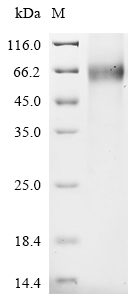
| Manufacturer: | Cusabio Biotech |
| Shelf Life: | 6 months |
| Molecular Weight: | 62.8 kda |
| Physical state: | Liquid or Lyophilized powder |
| Type: | Other Recombinant Protein |
| Alias: | Leucine-rich repeat-containing G-protein coupled receptor 4(G-protein coupled receptor 48) |
| Host Cell: | Baculovirus |
| Shipping Condition: | Blue Ice |
| Unit(s): | 1 mg, 100 ug, 20 ug |
| Host name: | |
| Clone: | |
| Isotype: | |
| Immunogen: |
Description
Description: Receptor for R-spondins that potentiates the canonical Wnt signaling pathway and is involved in the formation of various organs. Upon binding to R-spondins (RSPO1, RSPO2, RSPO3 or RSPO4), associates with phosphorylated LRP6 and frizzled receptors that are activated by extracellular Wnt receptors, triggering the canonical Wnt signaling pathway to increase expression of target genes. In contrast to classical G-protein coupled receptors, does not activate heterotrimeric G-proteins to transduce the signal. Its function as activator of the Wnt signaling pathway is required for the development of various organs, including liver, kidney, intestine, bone, reproductive tract and eye. May also act as a receptor for norrin (NDP), such results however require additional confirmation in vivo. Required during spermatogenesis to activate the Wnt signaling pathway in peritubular myoid cells. Required for the maintenance of intestinal stem cells and Paneth cell differentiation in postnatal intestinal crypts. Acts as a regulator of bone formation and remodeling. Involved in kidney development; required for maintaining the ureteric bud in an undifferentiated state. Involved in the development of the anterior segment of the eye. Required during erythropoiesis. Also acts as a negative regulator of innate immunity by inhibiting TLR2/TLR4 associated pattern-recognition and proinflammatory cytokine production. Plays an important role in regulating the circadian rhythms of plasma lipids, partially through regulating the rhythmic expression of MTTP (By similarity).
Additional Text
Gene ID
55366
Gene Name
LGR4
Uniprot ID
Q9BXB1
Protein Tag
6xHIS Tag
Storage Note
The shelf life is related to many factors, storage state, buffer ingredients, storage temperature and the stability of the protein itself. Generally, the shelf life of liquid form is 6 months at -20°C/-80°C. The shelf life of lyophilized form is 12 months at -20°C/-80°C.
 CSB-BP883618HU MSDS
SUPPORT
outstanding technical support

PRODUCT
we offer a full product guarantee

DELIVERY
we offer free delivery to UK universities and non profit organisations