Recombinant Human Tumor necrosis factor receptor superfamily member 14 (TNFRSF14), partial (Active)
Catalogue Number: CSB-MP842173HU-CSB
CSB-MP842173HU Image
CSB-MP842173HU Image
CSB-MP842173HU Image
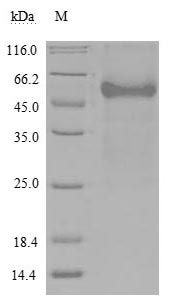
(Tris-Glycine gel) Discontinuous SDS-PAGE (reduced) with 5% enrichment gel and 15% separation gel.
CSB-MP842173HU Image
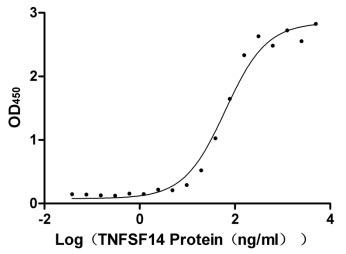
Measured by its binding ability in a functional ELISA. Immobilized TNFRSF14 at 5 µg/ml can bind human TNFSF14(CSB-MP023991HUj2), the EC50 is 49.85-79.31 ng/ml.
| Manufacturer: | Cusabio Biotech |
| Shelf Life: | 6 months |
| Molecular Weight: | 48.5 kDa |
| Physical state: | Lyophilized |
| Type: | Bioactive Proteins |
| Alias: | HVEA (HVEM) (UNQ329) (PRO509) (CD270) (TR2) (HveA) (Herpesvirus entry mediator A) |
| Host Cell: | Mammalian Cells |
| Shipping Condition: | Blue Ice |
| Unit(s): | 100 ug, 20 ug, 1 mg |
| Host name: | |
| Clone: | |
| Isotype: | |
| Immunogen: |
Description
Description: Receptor for four distinct ligands: The TNF superfamily members TNFSF14/LIGHT and homotrimeric LTA/lymphotoxin-alpha and the immunoglobulin superfamily members BTLA and CD160, altogether defining a complex stimulatory and inhibitory signaling network (PubMed:9462508, PubMed:10754304, PubMed:18193050, PubMed:23761635). Signals via the TRAF2-TRAF3 E3 ligase pathway to promote immune cell survival and differentiation (PubMed:19915044, PubMed:9153189, PubMed:9162022). Participates in bidirectional cell-cell contact signaling between antigen presenting cells and lymphocytes. In response to ligation of TNFSF14/LIGHT, delivers costimulatory signals to T cells, promoting cell proliferation and effector functions (PubMed:10754304). Interacts with CD160 on NK cells, enhancing IFNG production and anti-tumor immune response (PubMed:23761635). In the context of bacterial infection, acts as a signaling receptor on epithelial cells for CD160 from intraepithelial lymphocytes, triggering the production of antimicrobial proteins and proinflammatory cytokines (By similarity). Upon binding to CD160 on activated CD4+ T cells, downregulates CD28 costimulatory signaling, restricting memory and alloantigen-specific immune response (PubMed:18193050). May interact in cis (on the same cell) or in trans (on other cells) with BTLA (PubMed:19915044) (By similarity). In cis interactions, appears to play an immune regulatory role inhibiting in trans interactions in naive T cells to maintain a resting state. In trans interactions, can predominate during adaptive immune response to provide survival signals to effector T cells (PubMed:19915044)
Additional Text
Gene ID
8764
Uniprot ID
Q92956
Gene Name
TNFRSF14
Protein Tag
hFC Tag
Storage Note
The shelf life is related to many factors, storage state, buffer ingredients, storage temperature and the stability of the protein itself. Generally, the shelf life of liquid form is 6 months at -20°C/-80°C. The shelf life of lyophilized form is 12 months at -20°C/-80°C.
 CSB-MP842173HU MSDS
SUPPORT
outstanding technical support

PRODUCT
we offer a full product guarantee

DELIVERY
we offer free delivery to UK universities and non profit organisations