HLA-DRB1 Antibody, Biotin conjugated
Catalogue Number: CSB-PA17949D0RB-CSB
CSB-PA17949D0RB Image
CSB-PA17949D0RB Image
CSB-PA17949D0RB Image
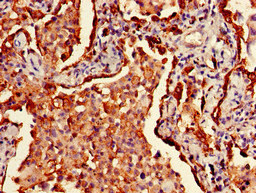
Immunohistochemistry of paraffin-embedded human lung cancer using CSB-PA17949D0Rb at dilution of 1:100
CSB-PA17949D0RB Image
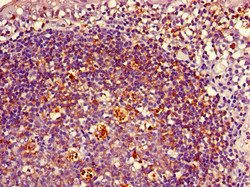
Immunohistochemistry of paraffin-embedded human tonsil tissue using CSB-PA17949D0Rb at dilution of 1:100
| Manufacturer: | Cusabio Biotech |
| Preservative: | 0.03% ProClin™ 300 |
| Ph: | 7.4 |
| Physical state: | Liquid |
| Type: | Polyclonal Primary Antibody - Conjugated |
| Alias: | HLA class II histocompatibility antigen, DRB1-3 chain (Clone P2-beta-3) (MHC class II antigen DRB1*3), HLA-DRB1 |
| Shipping Condition: | Blue Ice |
| Unit(s): | 100 ug, 50 ug |
| Host name: | Rabbit |
| Clone: | |
| Isotype: | IgG |
| Immunogen: | Recombinant Human HLA class II histocompatibility antigen, DRB1-3 chain protein (31-266AA) |
| Application: | ELISA, IHC |
Description
Description: Binds peptides derived from antigens that access the endocytic route of antigen presenting cells (APC) and presents them on the cell surface for recognition by the CD4 T-cells. The peptide binding cleft accommodates peptides of 10-30 residues. The peptides presented by MHC class II molecules are generated mostly by degradation of proteins that access the endocytic route; where they are processed by lysosomal proteases and other hydrolases. Exogenous antigens that have been endocytosed by the APC are thus readily available for presentation via MHC II molecules; and for this reason this antigen presentation pathway is usually referred to as exogenous. As membrane proteins on their way to degradation in lysosomes as part of their normal turn-over are also contained in the endosomal/lysosomal compartments; exogenous antigens must compete with those derived from endogenous components. Autophagy is also a source of endogenous peptides; autophagosomes constitutively fuse with MHC class II loading compartments. In addition to APCs; other cells of the gastrointestinal tract; such as epithelial cells; express MHC class II molecules and CD74 and act as APCs; which is an unusual trait of the GI tract. To produce a MHC class II molecule that presents an antigen; three MHC class II molecules (heterodimers of an alpha and a beta chain) associate with a CD74 trimer in the ER to form an heterononamer. Soon after the entry of this complex into the endosomal/lysosomal system where antigen processing occurs; CD74 undergoes a sequential degradation by various proteases; including CTSS and CTSL; leaving a small fragment termed CLIP (class-II-associated invariant chain peptide). The removal of CLIP is facilitated by HLA-DM via direct binding to the alpha-beta-CLIP complex so that CLIP is released. HLA-DM stabilizes MHC class II molecules until primary high affinity antigenic peptides are bound. The MHC II molecule bound to a peptide is then transported to the cell membrane surface. In B-cells; the interaction between HLA-DM and MHC class II molecules is regulated by HLA-DO. Primary dendritic cells (DCs) also to express HLA-DO. Lysosomal miroenvironment has been implicated in the regulation of antigen loading into MHC II molecules; increased acidification produces increased proteolysis and efficient peptide loading.
Additional Text
Gene Name
HLA-DRB1
Gene ID
3123
UniProt ID
P01912
Purification
Protein G purified
Storage Note
Upon receipt, store at -20°C or -80°C. Avoid repeated freeze.
Antibody Clonality
Polyclonal
 CSB-PA17949D0Rb Datasheet
SUPPORT
outstanding technical support

PRODUCT
we offer a full product guarantee

DELIVERY
we offer free delivery to UK universities and non profit organisations