Human SIRT3 protein, His tag
Catalogue Number: GTX00190-PRO-GTX
GTX00190-PRO Image
GTX00190-PRO Image
GTX00190-PRO Image
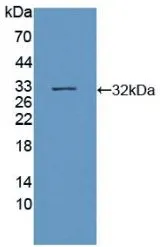
GTX00190-PRO Image
WB analysis of GTX00190-pro Human SIRT3 protein.
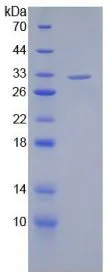
GTX00190-PRO Image
SDS-PAGE analysis of GTX00190-pro Human SIRT3 protein.
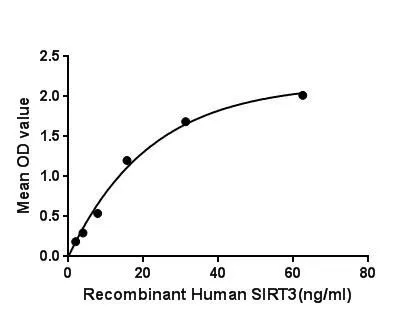
GTX00190-PRO Image
Functional ELISA analysis of GTX00190-pro Human SIRT3 protein which can bind immobilized IDH2 protein.
| Manufacturer: | GeneTex |
| Preservative: | ProClin™ 300 |
| Physical state: | Lyophilized |
| Type: | Modifying Enzymes |
| Alias: | sirtuin 3 , SIR2L3 |
| Host Cell: | E.coli |
| Shipping Condition: | Blue Ice |
| Unit(s): | 10 ug |
| Application: | FA |
Description
Description: This gene encodes a member of the sirtuin family of proteins, homologs to the yeast Sir2 protein. Members of the sirtuin family are characterized by a sirtuin core domain and grouped into four classes. The functions of human sirtuins have not yet been determined; however, yeast sirtuin proteins are known to regulate epigenetic gene silencing and suppress recombination of rDNA. Studies suggest that the human sirtuins may function as intracellular regulatory proteins with mono-ADP-ribosyltransferase activity. The protein encoded by this gene is included in class I of the sirtuin family. Two alternatively spliced transcript variants that encode different proteins have been described for this gene. [provided by RefSeq, Jul 2008]
Additional Text
Gene ID
23410
Uniprot ID
Q9NTG7
Gene Name
SIRT3
Accession Number
NP_001017524.1
Protein Tag
HIS Tag
Note
For laboratory use only. Not for any clinical, therapeutic, or diagnostic use in humans or animals. Not for animal or human consumption.
Application Notes
Sirtuin 3 (SIRT3), the NAD-dependent deacetylaseis is member of the mammalian sirtuin family of proteins. In human, sirtuins have a range of molecular functions and have emerged as important proteins in aging, stress resistance and metabolic regulation. It also can regulate epigenetic gene silencing and suppress recombination of rDNA in yeast. SIRT3 expression in white and brown adipose tissue. Besides, Isocitrate Dehydrogenase 2, mitochondrial (IDH2) has been identified as an interactor of SIRT3, thus a binding ELISA assay was conducted to detect the interaction of recombinant humant SIRT3 and recombinant human IDH2. Briefly, SIRT3 were diluted serially in PBS, with 0.01% BSA (pH 7.4). Duplicate samples of 100 µl were then transferred to IDH2-coated microtiter wells and incubated for 2h at 37C. Wells were washed with PBST and incubated for 1h with anti-SIRT3 pAb, then aspirated and washed 3 times. After incubation with HRP labelled secondary antibody, wells were aspirated and washed 3 times. With the addition of substrate solution, wells were incubated 15-25 minutes at 37C. Finally, add 50 µl stop solution to the wells and read at 450nm immediately. The binding activity of SIRT3 and IDH2 was in a dose dependent manner.
Storage Note
For short-term storage (1-2 weeks), store at 4C. For long-term storage, store at -20C or below. After reconstitution, keep as concentrated solution. Avoid freeze-thaw cycles.
 GTX00190-PRO Datasheet
SUPPORT
outstanding technical support

PRODUCT
we offer a full product guarantee

DELIVERY
we offer free delivery to UK universities and non profit organisations