Human VEGF Receptor 2 protein, His tag (active)
Catalogue Number: GTX00259-PRO-GTX
GTX00259-PRO Image
GTX00259-PRO Image
GTX00259-PRO Image
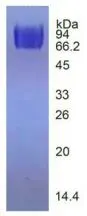
SDS-PAGE analysis of GTX00259-pro Human VEGF Receptor 2 protein (active).
GTX00259-PRO Image
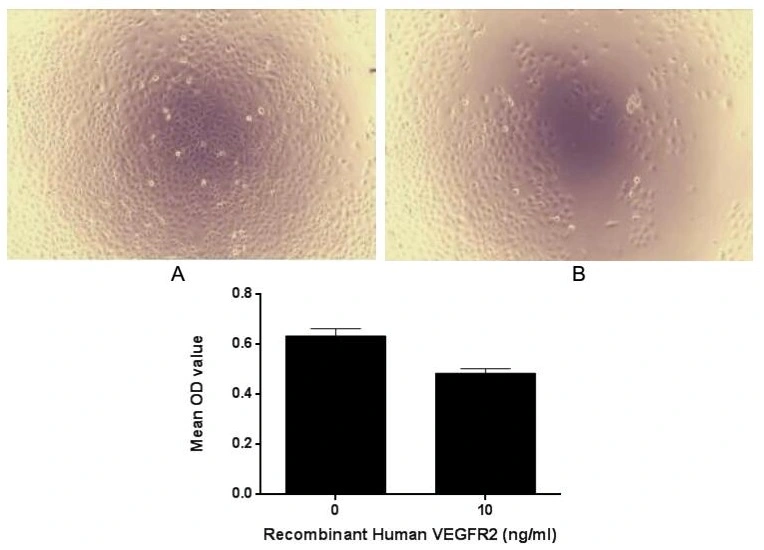
The inhibition effect of GTX00259-pro Human VEGF Receptor 2 protein (active) on VEGF-dependent proliferation. Cell viability was measured by Cell Counting Kit-8 (CCK-8). (A) Unstimulated ECV-304 cells cultured in DMEM for 96hrs. (B) ECV-304 cells cultured in DMEM, stimulated with 10 ng/ml VEGFR2 for 96hrs.
| Manufacturer: | GeneTex |
| Preservative: | ProClin™ 300 |
| Physical state: | Lyophilized |
| Type: | Protein Kinases |
| Alias: | kinase insert domain receptor , CD309 , FLK1 , VEGFR , VEGFR2 |
| Host Cell: | HEK293 cells |
| Shipping Condition: | Blue Ice |
| Unit(s): | 10 ug |
| Application: | FA |
Description
Description: Vascular endothelial growth factor (VEGF) is a major growth factor for endothelial cells. This gene encodes one of the two receptors of the VEGF. This receptor, known as kinase insert domain receptor, is a type III receptor tyrosine kinase. It functions as the main mediator of VEGF-induced endothelial proliferation, survival, migration, tubular morphogenesis and sprouting. The signalling and trafficking of this receptor are regulated by multiple factors, including Rab GTPase, P2Y purine nucleotide receptor, integrin alphaVbeta3, T-cell protein tyrosine phosphatase, etc.. Mutations of this gene are implicated in infantile capillary hemangiomas. [provided by RefSeq, May 2009]
Additional Text
Gene Name
KDR
Gene ID
3791
Uniprot ID
P35968
Accession Number
NP_002244.1
Protein Tag
HIS Tag
Note
For laboratory use only. Not for any clinical, therapeutic, or diagnostic use in humans or animals. Not for animal or human consumption.
Application Notes
Vascular Endothelial Growth Factor Receptor 2 (VEGFR2) also known as kinase insert domain receptor acts as a cell-surface receptor for VEGFA, VEGFC and VEGFD. VEGFR2 functions as the primary mediator of vascular endothelial growth factor activation in endothelial cells. regulation of VEGFR-2 expression appears critical in mitogenesis, differentiation, and angiogenesis. To test the effect on inhibit the VEGF-dependent proliferation of endothelium cells, ECV-304 cells were seeded into triplicate wells of 96-well plates at a density of 5000 cells/well and allowed to attach, replaced with serum-free overnight, then the medium was replaced with 2% serum standard DMEM including 1µg/ml Vascular Endothelial Growth Factor C (VEGFC) and various concentrations of recombinant human VEGFR2. After incubated for 96h, cells were observed by inverted microscope and cell proliferation was measured by Cell Counting Kit-8 (CCK-8). Briefly, 10 µl of CCK-8 solution was added to each well of the plate, then the absorbance at 450nm was measured using a microplate reader after incubating the plate for 1-4 hours at 37C. Proliferation of ECV-304 cells after incubation with VEGFR2 for 96h observed by inverted microscope.
Storage Note
For short-term storage (1-2 weeks), store at 4C. For long-term storage, store at -20C or below. After reconstitution, keep as concentrated solution. Avoid freeze-thaw cycles.
 GTX00259-PRO Datasheet
SUPPORT
outstanding technical support

PRODUCT
we offer a full product guarantee

DELIVERY
we offer free delivery to UK universities and non profit organisations