Mouse Asporin protein, His tag
Catalogue Number: GTX00331-PRO-GTX
| Manufacturer: | GeneTex |
| Preservative: | ProClin™ 300 |
| Physical state: | Lyophilized |
| Type: | Other Proteins |
| Alias: | asporin , 4631401G09Rik , AA986886 , Plap1 , Slrr1c |
| Host Cell: | E.coli |
| Shipping Condition: | Blue Ice |
| Unit(s): | 10 ug |
| Application: | FA, BndA |
Description
Description: This gene encodes a member of the small leucine-rich proteoglycan family. The encoded protein is an extracellular matrix protein that modulates the transforming growth factor-beta signaling pathway, regulating cartilage matrix gene expression and cartilage formation. The protein plays a role in the pathology of osteoarthritis. Alternative splicing results in multiple transcript variants.[provided by RefSeq, Feb 2010]
Additional Text
Gene Name
ASPN
Protein Tag
HIS Tag
Gene ID
66695
Uniprot ID
Q99MQ4
Note
For laboratory use only. Not for any clinical, therapeutic, or diagnostic use in humans or animals. Not for animal or human consumption.
Accession Number
NP_001165952.1
Storage Note
For short-term storage (1-2 weeks), store at 4C. For long-term storage, store at -20C or below. After reconstitution, keep as concentrated solution. Avoid freeze-thaw cycles.
Application Notes
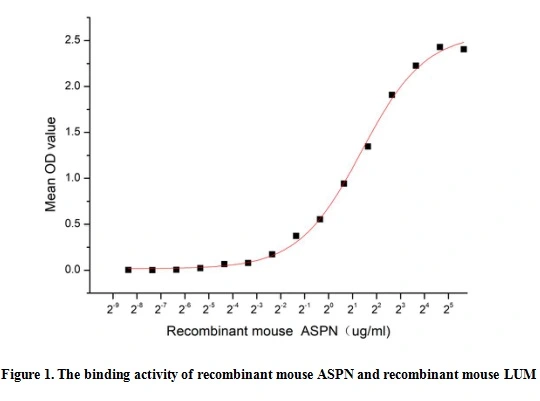
Asporin (ASPN) is a protein belongs to a family of leucine-rich repeat (LRR) proteins implicated in cancer, osteoarthritis, and periodontal ligament mineralization. The protein negatively regulates chondrogenesis in the articular cartilage and periodontal ligament (PDL) differentiation, inhibits BMP2-induced cytodifferentiation of PDL cells and also nhibits the interaction between TGFB1 and TGF-beta receptor type II in the presence of heparin/heparan sulfate in vitro. In addition Lumican (LUM) and ASPN can contribute to the fibrinogenesis of cardiac remodeling of ICM, thus a binding ELISA assay was conducted to detect the interaction of recombinant mouse ASPN and recombinant mouse LUM. Briefly, ASPN were diluted serially in PBS, with 0.01% BSA (pH 7.4). Duplicate samples of 100 µl were then transferred to LUM-coated microtiter wells and incubated for 2h at 37C. Wells were washed with PBST and incubated for 1h with anti-ASPN pAb, then aspirated and washed 3 times. After incubation with HRP labelled secondary antibody, wells were aspirated and washed 3 times. With the addition of substrate solution, wells were incubated 15-25 minutes at 37C. Finally, add 50 µL stop solution to the wells and read at 450 nm immediately. The binding activity of recombinant mouse ASPN and recombinant mouse LUM was shown in the Figure, the EC50 for this effect is 2.6 µg/ml.
 GTX00331-PRO Datasheet
SUPPORT
outstanding technical support

PRODUCT
we offer a full product guarantee

DELIVERY
we offer free delivery to UK universities and non profit organisations