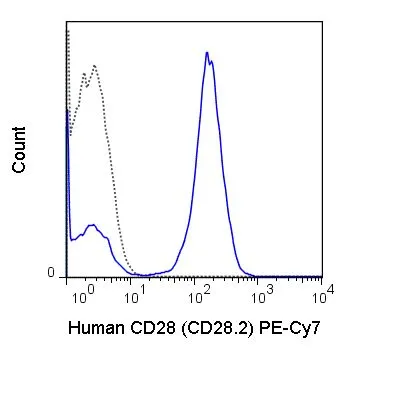
CD28 antibody [CD28.2] (PE-Cy7)
Catalogue Number: GTX00602-10-GTX
| Manufacturer: | GeneTex |
| Preservative: | 0.09% sodium azide |
| Molecular Weight: | 25 |
| Physical state: | Liquid |
| Type: | Monoclonal Primary Antibody - Conjugated |
| Alias: | CD28 molecule , Tp44 |
| Shipping Condition: | Blue Ice |
| Unit(s): | 100 tests |
| Host name: | Mouse |
| Clone: | CD28.2 |
| Isotype: | IgG1 |
| Immunogen: | DC28.1.3.3 murine T cell hybridoma transfected with human CD28 cDNA |
| Application: | FC |
Description
Description: The protein encoded by this gene is essential for T-cell proliferation and survival, cytokine production, and T-helper type-2 development. Several alternatively spliced transcript variants encoding different isoforms have been found for this gene.[provided by RefSeq, Jul 2011]
Additional Text
Gene ID
940
Gene Name
CD28
Uniprot ID
P10747
Concentration
0.05 mg/mL
Purification
Affinity Purified
Antibody Clonality
Monoclonal
Note
For In vitro laboratory use only. Not for any clinical, therapeutic, or diagnostic use in humans or animals. Not for animal or human consumption
Short Description
The CD28.2 antibody reacts with human CD28, a 44 kDa type I surface glycoprotein which acts as a co-stimulatory receptor in support of the T cell receptor (TCR). CD28 exists as a homodimer with specificity for two known ligands, known as B7-1 (CD80) and B7-2 (CD86), which are expressed on activated B cells and antigen-presenting cells. These ligands trigger CD28 signaling in concert with TCR activation to drive T cell proliferation, induce high-level expression of IL-2, impart resistance to apoptosis, and enhance T cell cytotoxicity. The interaction / co-stimulatory signaling between the B7 ligands and CD28 provides crucial communication between T cells and B cells or APCs to coordinate the adaptive immune response. Other members of the CD28 family of receptors include CTLA-4 (CD152), PD-1 (CD279), ICOS and BTLA.
Storage Note
Store as concentrated solution. Centrifuge briefly prior to opening vial. Store at 4C. DO NOT FREEZE. Protect from light.
Application Notes
FCM: 0.25 µg (5 µl) for 10⁵-10⁸ cells in 100 µl sample per test. *Optimal dilutions/concentrations should be determined by the researcher.Not tested in other applications.
 GTX00602-10 Datasheet
SUPPORT
outstanding technical support

PRODUCT
we offer a full product guarantee

DELIVERY
we offer free delivery to UK universities and non profit organisations