Human FGFR1 alpha IIIc (extracellular region) protein, His tag
Catalogue Number: GTX02782-PRO-GTX
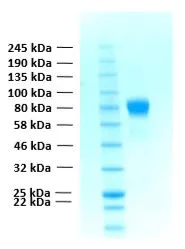
| Manufacturer: | GeneTex |
| Preservative: | no preservative|No preservative |
| Physical state: | Liquid |
| Type: | Protein Kinases |
| Alias: | fibroblast growth factor receptor 1 , BFGFR , CD331 , CEK , ECCL , FGFBR , FGFR-1 , FLG , FLT-2 , FLT2 , HBGFR , HH2 , HRTFDS , KAL2 , N-SAM , OGD , bFGF-R-1 |
| Host Cell: | HEK293 cells |
| Shipping Condition: | Dry Ice |
| Unit(s): | 50 ug |
| Application: | FA |
Description
Description: The protein encoded by this gene is a member of the fibroblast growth factor receptor (FGFR) family, where amino acid sequence is highly conserved between members and throughout evolution. FGFR family members differ from one another in their ligand affinities and tissue distribution. A full-length representative protein consists of an extracellular region, composed of three immunoglobulin-like domains, a single hydrophobic membrane-spanning segment and a cytoplasmic tyrosine kinase domain. The extracellular portion of the protein interacts with fibroblast growth factors, setting in motion a cascade of downstream signals, ultimately influencing mitogenesis and differentiation. This particular family member binds both acidic and basic fibroblast growth factors and is involved in limb induction. Mutations in this gene have been associated with Pfeiffer syndrome, Jackson-Weiss syndrome, Antley-Bixler syndrome, osteoglophonic dysplasia, and autosomal dominant Kallmann syndrome 2. Chromosomal aberrations involving this gene are associated with stem cell myeloproliferative disorder and stem cell leukemia lymphoma syndrome. Alternatively spliced variants which encode different protein isoforms have been described; however, not all variants have been fully characterized. [provided by RefSeq, Jul 2008]
Additional Text
Gene ID
2260
Uniprot ID
P11362
Protein Tag
HIS Tag
Gene Name
FGFR1
Note
For In vitro laboratory use only. Not for any clinical, therapeutic, or diagnostic use in humans or animals. Not for animal or human consumption
Storage Note
Store as concentrated solution. Centrifuge briefly prior to opening vial. For short-term storage (at least 1 month), store at 4C. For long-term storage, aliquot and store at -20C or below. Avoid multiple freeze-thaw cycles.
 GTX02782-PRO Datasheet
SUPPORT
outstanding technical support

PRODUCT
we offer a full product guarantee

DELIVERY
we offer free delivery to UK universities and non profit organisations