sRANKL antibody
Catalogue Number: GTX10343-GTX
GTX10343 Image
GTX10343 Image
GTX10343 Image
GTX10343 Image
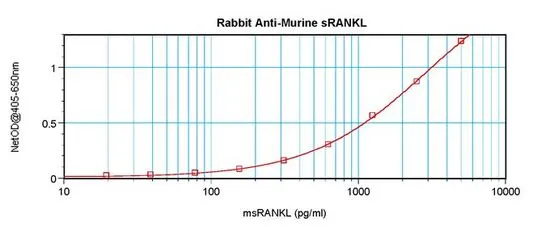
ELISA analysis of mouse RANKL recombinant protein (0.2 - 0.4 ng/well) using GTX10343 sRANKL antibody(capture antibody) at 0.5 - 2.0 ug/ml and Biotinylated Anti-Murine sRANKL as a detection antibody.
GTX10343 Image
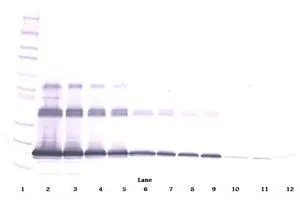
WB analysis of sequential diluted mouse RANKL recombinant protein under either reducing or non-reducing conditions using GTX10343 sRANKL antibody. Working concentration : 0.1 - 0.2 ug/ml
GTX10343 Image
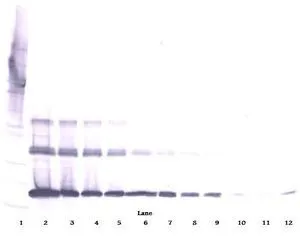
WB analysis of sequential diluted mouse RANKL recombinant protein under either reducing or non-reducing conditions using GTX10343 sRANKL antibody. Working concentration : 0.1 - 0.2 ug/ml
| Manufacturer: | GeneTex |
| Preservative: | no preservative|No preservative |
| Molecular Weight: | 35 |
| Physical state: | Liquid |
| Type: | Polyclonal Primary Antibody - Unconjugated |
| Alias: | tumor necrosis factor (ligand) superfamily, member 11 , Ly109l , ODF , OPGL , RANKL , Trance |
| Shipping Condition: | Blue Ice |
| Unit(s): | 50 ug |
| Host name: | Goat |
| Clone: | |
| Isotype: | IgG |
| Immunogen: | Produced from sera of rabbits pre-immunized with highly pure (>98%) recombinant msRANKL (murine sRANK Ligand). |
| Application: | ELISA, sELISA, WB |
Description
Description: TRANCE, also called RANKL (RANK ligand), OPGL (Osteoprotegrin ligand), and ODF (Osteoclast differentiation factor), is a type II transmembrane signaling protein of the TNF superfamily. The extracellular domain contains two potential N-linked glycosylation sites. Mouse TRANCE cDNA encodes a 316 amino acid protein with a calculated molecular mass of approximately 28 kDa. As a result of glycosylation, recombinant mouse TRANCE migrates as an approximately 36 kDa protein in SDS-PAGE. Human and mouse TRANCE share approximately 85% amino acid sequence identity. TRANCE was originally identified as an immediate early gene upregulated by T cell receptor stimulation. It is a key regulator of the immune system and of bone development and homeostasis. Multi-functions of TRANCE include induction of activation of c-jun N-terminal kinase in T cells, enhancement of T cell growth and dendritic cell function, induction of osteoclastogenesis and lymph node organogenesis. The cell surface signaling receptor of TRANCE (RANKL) is RANK which undergoes receptor clustering during signal transduction. TRANCE is highly expressed in thymus and lymph nodes but not in nonlymphoid tissues.1 It is abundantly expressed in T cells but not in B cells. TRANCE activates mature dendritic cells, inducing cytokine production, suggesting that it is a factor in the T cell dentritic cell interaction during an immune response. TRANCE expression is found on osteoblasts and regulates osteoclast differentiation function.
Additional Text
Uniprot ID
O35235
Gene Name
TNFSF11
Gene ID
21943
Purification
Affinity Purified
Antibody Clonality
Polyclonal
Note
For In vitro laboratory use only. Not for any clinical, therapeutic, or diagnostic use in humans or animals. Not for animal or human consumption
Molecular Weight
35
Storage Note
Store as concentrated solution. Centrifuge briefly prior to opening vial. For short-term storage (1-2 weeks), store at 4C. For long-term storage, aliquot and store at -20C or below. Avoid multiple freeze-thaw cycles.
Application Notes
WB: 0.1 - 0.2 µg/mL. ELISA: 0.5 µg/mL. Sandwich ELISA: 0.5 - 2.0 µg/ml. *Optimal dilutions/concentrations should be determined by the researcher.Not tested in other applications.
 GTX10343 Datasheet
SUPPORT
outstanding technical support

PRODUCT
we offer a full product guarantee

DELIVERY
we offer free delivery to UK universities and non profit organisations