LIM kinase 2 antibody
Catalogue Number: GTX108903-GTX
GTX108903 Image
GTX108903 Image
GTX108903 Image
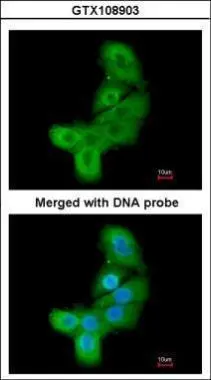
GTX108903 Image
Immunofluorescence analysis of paraformaldehyde-fixed A549, using LIM kinase 2(GTX108903) antibody at 1:200 dilution.
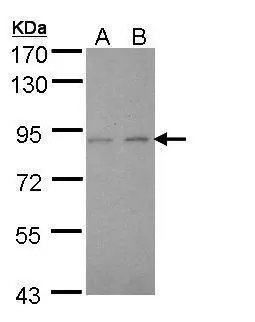
GTX108903 Image
Sample (30 ug of whole cell lysate) A: A431 (GTX27909) B: H1299 7.5% SDS PAGE GTX108903 diluted at 1:2000
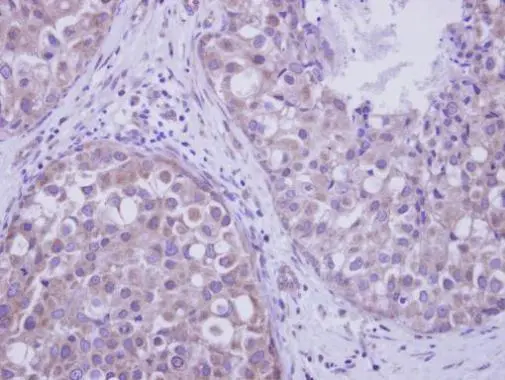
GTX108903 Image
Immunohistochemical analysis of paraffin-embedded human breast cancer, using LIM kinase 2(GTX108903) antibody at 1:250 dilution. Antigen Retrieval: Trilogy? (EDTA based, pH 8.0) buffer, 15min
| Manufacturer: | GeneTex |
| Preservative: | 0.01% Thimerosal|0.01% Thimerosal |
| Molecular Weight: | 72 |
| Physical state: | Liquid |
| Type: | Polyclonal Primary Antibody - Unconjugated |
| Alias: | LIM domain kinase 2 |
| Shipping Condition: | Blue Ice |
| Unit(s): | 100 ul, 25 ul |
| Host name: | Rabbit |
| Clone: | |
| Isotype: | IgG |
| Immunogen: | Recombinant protein encompassing a sequence within the center region of human LIM kinase 2. The exact sequence is proprietary. |
| Application: | ICC, IF, IHC-P, WB |
Description
Description: There are approximately 40 known eukaryotic LIM proteins, so named for the LIM domains they contain. LIM domains are highly conserved cysteine-rich structures containing 2 zinc fingers. Although zinc fingers usually function by binding to DNA or RNA, the LIM motif probably mediates protein-protein interactions. LIM kinase-1 and LIM kinase-2 belong to a small subfamily with a unique combination of 2 N-terminal LIM motifs and a C-terminal protein kinase domain. The protein encoded by this gene is phosphorylated and activated by ROCK, a downstream effector of Rho, and the encoded protein, in turn, phosphorylates cofilin, inhibiting its actin-depolymerizing activity. It is thought that this pathway contributes to Rho-induced reorganization of the actin cytoskeleton. At least three transcript variants encoding different isoforms have been found for this gene. [provided by RefSeq]
Additional Text
Gene ID
3985
Gene Name
LIMK2
Uniprot ID
P53671
Purification
Affinity Purified
Molecular Weight
72
Antibody Clonality
Polyclonal
Note
For In vitro laboratory use only. Not for any clinical, therapeutic, or diagnostic use in humans or animals. Not for animal or human consumption
Concentration
1 mg/ml
Application Notes
WB: 1:500-1:3000. ICC/IF: 1:100-1:1000. IHC-P: 1:100-1:1000. *Optimal dilutions/concentrations should be determined by the researcher.Not tested in other applications.
Storage Note
Store as concentrated solution. Centrifuge briefly prior to opening vial. For short-term storage (1-2 weeks), store at 4C. For long-term storage, aliquot and store at -20C or below. Avoid multiple freeze-thaw cycles.
 GTX108903 Datasheet
SUPPORT
outstanding technical support

PRODUCT
we offer a full product guarantee

DELIVERY
we offer free delivery to UK universities and non profit organisations