beta A4 Crystallin antibody [N1C3-2]
Catalogue Number: GTX109526-GTX
GTX109526 Image
GTX109526 Image
GTX109526 Image
GTX109526 Image
GTX109526 Image
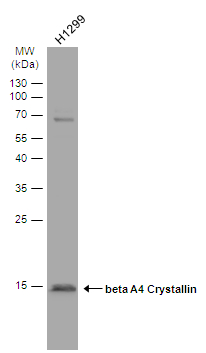
Whole cell extract (30 µg) was separated by 12% SDS-PAGE, and the membrane was blotted with beta A4 Crystallin antibody [N1C3-2] (GTX109526) diluted at 1:1000. The HRP-conjugated anti-rabbit IgG antibody (GTX213110-01) was used to detect the primary antibody.
GTX109526 Image
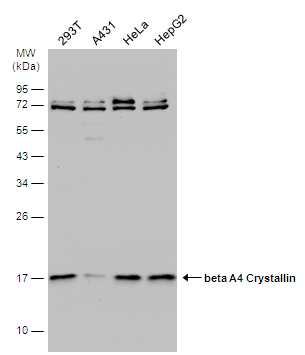
Various whole cell extracts (30 µg) were separated by 12% SDS-PAGE, and the membrane was blotted with beta A4 Crystallin antibody [N1C3-2] (GTX109526) diluted at 1:1000. The HRP-conjugated anti-rabbit IgG antibody (GTX213110-01) was used to detect the primary antibody.
GTX109526 Image
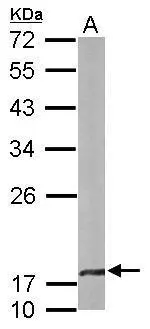
Sample (50 ug of whole cell lysate) A: mouse brain 12% SDS PAGE GTX109526 diluted at 1:1000
GTX109526 Image
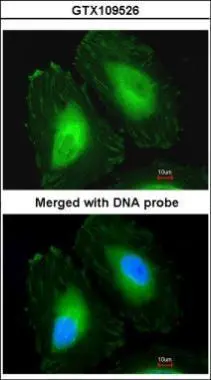
Immunofluorescence analysis of paraformaldehyde-fixed HeLa, using Beta-crystallin A4(GTX109526) antibody at 1:200 dilution.
| Manufacturer: | GeneTex |
| Preservative: | 0.01% Thimerosal|0.01% Thimerosal |
| Molecular Weight: | 22 |
| Physical state: | Liquid |
| Type: | Polyclonal Primary Antibody - Unconjugated |
| Alias: | crystallin beta A4 , CTRCT23 , CYRBA4 , MCOPCT4 |
| Shipping Condition: | Blue Ice |
| Unit(s): | 100 ul, 25 ul |
| Host name: | Rabbit |
| Clone: | |
| Isotype: | IgG |
| Immunogen: | Recombinant protein encompassing a sequence within the center region of human beta A4 Crystallin. The exact sequence is proprietary. |
| Application: | ICC, IF, WB |
Description
Description: Crystallins are separated into two classes: taxon-specific, or enzyme, and ubiquitous. The latter class constitutes the major proteins of vertebrate eye lens and maintains the transparency and refractive index of the lens. Since lens central fiber cells lose their nuclei during development, these crystallins are made and then retained throughout life, making them extremely stable proteins. Mammalian lens crystallins are divided into alpha, beta, and gamma families; beta and gamma crystallins are also considered as a superfamily. Alpha and beta families are further divided into acidic and basic groups. Seven protein regions exist in crystallins: four homologous motifs, a connecting peptide, and N- and C-terminal extensions. Beta-crystallins, the most heterogeneous, differ by the presence of the C-terminal extension (present in the basic group, none in the acidic group). Beta-crystallins form aggregates of different sizes and are able to self-associate to form dimers or to form heterodimers with other beta-crystallins. This gene, a beta acidic group member, is part of a gene cluster with beta-B1, beta-B2, and beta-B3. [provided by RefSeq]
Additional Text
Gene Name
CRYBA4
Uniprot ID
P53673
Purification
Affinity Purified
Gene ID
1413
Antibody Clonality
Polyclonal
Note
For In vitro laboratory use only. Not for any clinical, therapeutic, or diagnostic use in humans or animals. Not for animal or human consumption
Molecular Weight
22
Concentration
1 mg/ml
Application Notes
WB: 1:500-1:3000. ICC/IF: 1:100-1:1000. *Optimal dilutions/concentrations should be determined by the researcher.Not tested in other applications.
Storage Note
Store as concentrated solution. Centrifuge briefly prior to opening vial. For short-term storage (1-2 weeks), store at 4C. For long-term storage, aliquot and store at -20C or below. Avoid multiple freeze-thaw cycles.
 GTX109526 Datasheet
SUPPORT
outstanding technical support

PRODUCT
we offer a full product guarantee

DELIVERY
we offer free delivery to UK universities and non profit organisations