S100 beta antibody [SH-B4]
Catalogue Number: GTX11179-GTX
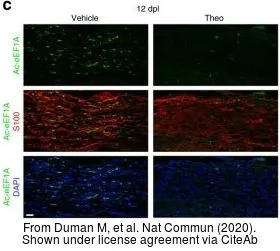
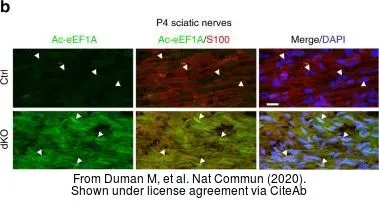
| Manufacturer: | GeneTex |
| Preservative: | 15 mM Sodium azide |
| Molecular Weight: | 11 |
| Physical state: | Liquid |
| Type: | Monoclonal Primary Antibody - Unconjugated |
| Alias: | S100 calcium binding protein B , NEF , S100 , S100-B , S100beta |
| Shipping Condition: | Blue Ice |
| Unit(s): | 100 ul |
| Host name: | Mouse |
| Clone: | SH-B4 |
| Isotype: | IgG1 |
| Immunogen: | bovine brain S-100b |
| Application: | ELISA, ICC, IF, IHC-P, IHC-Fr |
Description
Description: S100 is a set of small, thermolabile, highly acidic dimer proteins, of approx. 20 kDa, widely distributed in different tissues. Dimeric combinations of two chains; the alpha chain (93 a.a. 10.4 kDa) and the beta chain (91 a.a. 10.5 kDa), form the three known subtypes of S100 [S100ao (alpha alpha), S100a (alpha beta) and S100b (beta beta). Although there is slight variation in the primary structure in different species, the S100 molecule is markedly conserved in the amino acid sequence, and the protein extracted from different organs of the same species is identical. The alpha and beta chains are 58% homologous (54 a.a.) and both have divalent cation binding sites situated toward the carboxy terminus and apparently similar functional features. S100 can be grouped with other calcium binding proteins, to which it has a significant sequence homology, particularly around the calcium binding domain, such as calmodulin, parvalbumin, intestinal calcium binding protein, myosin light chain, and troponin-C. Hence, S100 is a calcium modulated protein that binds calcium and zinc ions reversibly at physiologic pH and ionic strength, followed by a conformational change in the molecule. S100 is considered to be a cell-growth regulator, but other functions have been suggested, e.g., increasing the membrane permeability to cations under physiologic conditions, stimulation of nucleolar RNA polymerase activity, interaction with the tumor suppressor protein p53 and as a carrier of proteins and free fatty acids in adipocytes. Human S100 containing cells are subdivided to three groups, S100b containing cells (such as Schwann cells, pituicytes of the neurohypophysis, Langerhanis cells, and interdigitating cells), S100a containing cells (such as glial cells and melanocytes) and S100ao containing cells (such as neurons, ganglion cells, slow skeletal muscle cells, cardiac cells, monocytes and some macrophages). Although the tissue distribution of S100 is too broad to conform to a single histogenetic pattern, it is sufficiently restricted that the localization of this protein is useful in the differential diagnosis of neoplasms and proliferative processes. Monoclonal antibody reacting specifically with the beta subunit of S100 may be use to distinguish malignant melanoma from undifferentiated carcinoma or lymphoma, and to distinguish leiomyomas from schwannomas and their counterparts in the gastrointestinal tract.
Additional Text
Gene Name
S100B
Uniprot ID
P04271
Gene ID
6285
Purification
Unpurified
Antibody Clonality
Monoclonal
Note
For In vitro laboratory use only. Not for any clinical, therapeutic, or diagnostic use in humans or animals. Not for animal or human consumption
Application Notes
IHC-P: 1:100. *Optimal dilutions/concentrations should be determined by the researcher.Not tested in other applications.
Storage Note
Store as concentrated solution. Centrifuge briefly prior to opening vial. For short-term storage (1-2 weeks), store at 4C. For long-term storage, aliquot and store at -20C or below. Avoid multiple freeze-thaw cycles.
 GTX11179 Datasheet
SUPPORT
outstanding technical support

PRODUCT
we offer a full product guarantee

DELIVERY
we offer free delivery to UK universities and non profit organisations