Connexin 43 antibody
Catalogue Number: GTX11370-GTX
GTX11370 Image
GTX11370 Image
GTX11370 Image
GTX11370 Image
GTX11370 Image
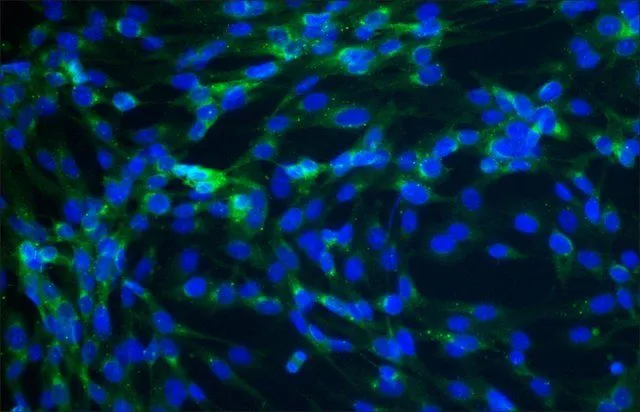
ICC/IF analysis of BHK cells using GTX11370 Connexin 43 antibody at 1:400(green) with DAPI(blue). Cells were fixed and permeabilized with methanol followed by methanol:acetone.
GTX11370 Image
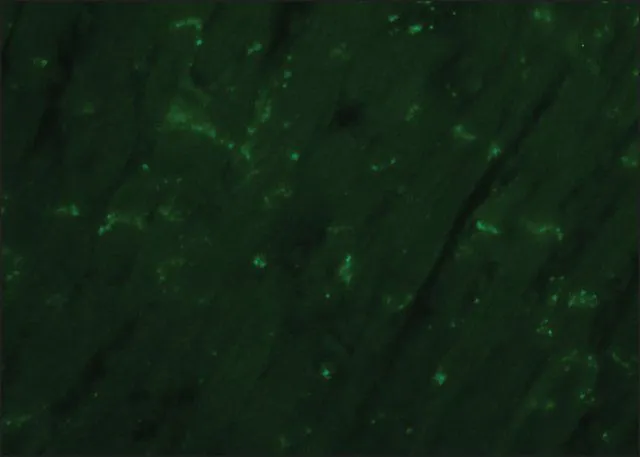
IHC-P analysis of human heart tissue using GTX11370 Connexin 43 antibody at 1:2000.
GTX11370 Image
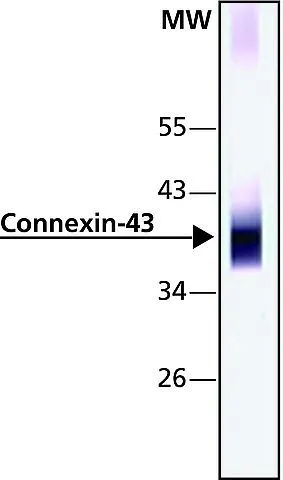
WB analysis of mouse brain extract using GTX11370 Connexin 43 antibody at 1:8000.
GTX11370 Image
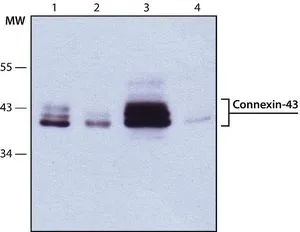
WB analysis of (1) HEK-293 (2) P19 (3) Rat2 (4) MDCK cells using GTX11370 Connexin 43 antibody at 1:2000.
| Manufacturer: | GeneTex |
| Preservative: | 15 mM Sodium azide |
| Molecular Weight: | 43 |
| Physical state: | Liquid |
| Type: | Polyclonal Primary Antibody - Unconjugated |
| Alias: | gap junction protein alpha 1 , AVSD3 , CMDR , CX43 , EKVP , EKVP3 , GJAL , HLHS1 , HSS , ODDD , PPKCA |
| Shipping Condition: | Blue Ice |
| Unit(s): | 100 ul |
| Host name: | Rabbit |
| Clone: | |
| Isotype: | IgG |
| Immunogen: | synthetic peptide corresponding to the C-terminal segment of the cytoplasmic domain (amino acids 363-382 with N-terminally added lysine) of human/rat connexin-43. |
| Application: | ICC, IF, IHC-P, WB, IHC-Fr |
Description
Description: Gap junctions are aggregations of intercellular channels, which directly connect the cytoplasm of adjacent cells. Gap junctions coordinate cellular and organ function in tissues and are involved in metabolic cooperation between cells, synchronization of cellular physiological activities, growth control, and developmental regulation. The gap junction channels allow intercellular exchange of ions, nucleotides, and small molecules between adjacent cells. Unlike other membrane channels, intercellular channels span two plasma membranes and require the contribution of hemi-channels, called connexons, from both participating cells. These channels accommodate molecules as large as 1 kDa. They have been detected in virtually every cell type in mammals, except mature skeletal muscle, spermatozoa, and erythrocytes. Two connexons interact in the extracellular space to form the complete intercellular channel. Each connexon is composed of six similar or identical proteins, which have been termed connexins. Connexins (Cx) are a multi-gene family of highly related proteins with molecular weights between 26 and 70 kDa. At least a dozen distinct connexin genes have been identified; many of them expressed in a tissue-specific manner. Two distinct lineages have been identified in mammals. One termed class I or beta group consists of Cx26, Cx30, Cx31, Cx31.1, and Cx32. The other, termed class II or alpha group, is represented by Cx33, Cx37, Cx40, Cx43 and Cx46. All of the connexins share a common membrane topology but differ in their conductance and channel gating properties. The structure of connexin molecules includes a cytoplasmic N-terminal region, four transmembrane domains, two extracellular loops, and a C-terminal cytoplasmic tail of varying length. The various connexins are highly conserved in the transmembrane and extracellular regions, but they differ in their cytoplasmic domain. The 43 kDa connexin protein (connexin 43, Cx43) belongs to the alpha type (group II) subfamily of connexin proteins. It is expressed in most tissues, even though the pattern of expression may differ in various cell types. For example, in the brain it is found in astrocytes, ependyma and leptomeninges but not in neurons, oligodendrocytes and pinealocytes; in the liver it is present in Ito cells but not hepatocytes. Gap junction protein levels change in response to disruption of tissue architecture. For instance, an increased expression of Cx43 was found in early stages of atherosclerosis. Changes in the levels or types of connexin expressed in a given cell type have been found to correlate with tumor progression and metastasis. However, glioma cells transfected with the oncogene neu (c-erb-B2) have been shown to exhibit a major reduction in intercellular communication with no decrease in overall expression of Cx43. Monoclonal antibodies reacting specifically with Cx43 may be applied in diverse cellular and molecular approaches to study gap junctions and their properties. They can also be used to correlate their expression pattern with physiological functions or pathological conditions.
Additional Text
Gene Name
GJA1
Gene ID
2697
Uniprot ID
P17302
Purification
Affinity Purified
Antibody Clonality
Polyclonal
Note
For In vitro laboratory use only. Not for any clinical, therapeutic, or diagnostic use in humans or animals. Not for animal or human consumption
Molecular Weight
43
Application Notes
WB: 1:8,000. ICC/IF: 1:400. IHC-P: 1:2,000. IHC-Fr: 1:2,000. *Optimal dilutions/concentrations should be determined by the researcher.Not tested in other applications.
Storage Note
Store as concentrated solution. Centrifuge briefly prior to opening vial. For short-term storage (1-2 weeks), store at 4C. For long-term storage, aliquot and store at -20C or below. Avoid multiple freeze-thaw cycles.
 GTX11370 Datasheet
SUPPORT
outstanding technical support

PRODUCT
we offer a full product guarantee

DELIVERY
we offer free delivery to UK universities and non profit organisations