NFkB p65 antibody [112A1021]
Catalogue Number: GTX13594-GTX
GTX13594 Image
GTX13594 Image
GTX13594 Image
GTX13594 Image
GTX13594 Image
GTX13594 Image
GTX13594 Image
GTX13594 Image
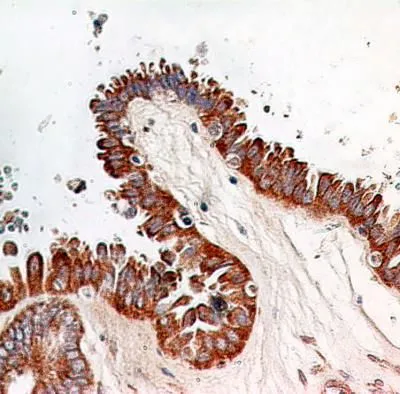
IHC-P analysis of human ovarian cystadenocarcinoma tissue using GTX13594 NFkB p65 antibody [112A1021]. Dilution : 5 µg/ml Antigen retrieval : 10 mM sodium citrate buffer, pH 6.0
GTX13594 Image
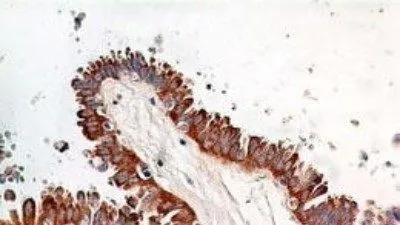
IHC-P analysis of human ovarian cystadenocarcinoma tissue using GTX13594 NFkB p65 antibody [112A1021]. Dilution : 5 µg/ml
GTX13594 Image
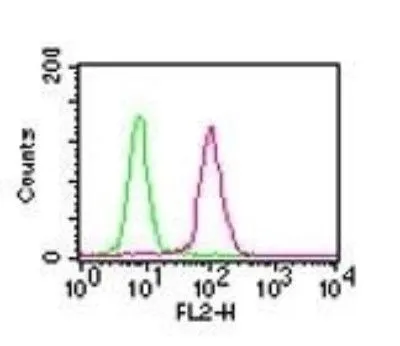
FACS (Intracellular staining) analysis of HEK293 cells using GTX13594 NFkB p65 antibody [112A1021]. Red : primary antibody Green : isotype control Antibody amount : 0.5µg
GTX13594 Image
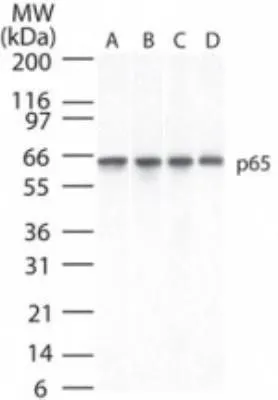
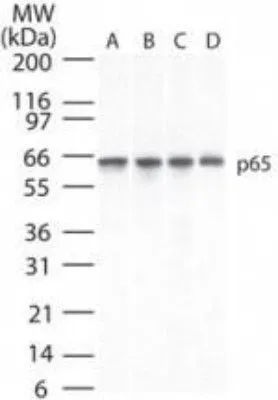
WB analysis of (A) Ramos, B) Daudi, C) HeLa and D) NIH 3T3 cell lysates using GTX13594 NFkB p65 antibody [112A1021]. Loading : 30µg Dilution : 2 µg/ml
GTX13594 Image
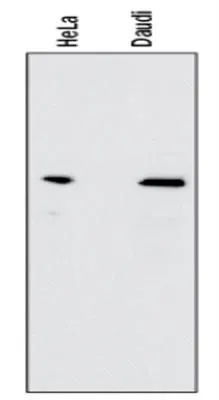
WB analysis of Daudi, HeLa cell lysates using GTX13594 NFkB p65 antibody [112A1021]. Dilution : 1 µg/ml
GTX13594 Image
WB analysis of (A) Ramos, B) Daudi, C) HeLa and D) mouse NIH 3T3 cell lysates using GTX13594 NFkB p65 antibody [112A1021]. Loading : 30µg Dilution : 2 µg/ml
GTX13594 Image
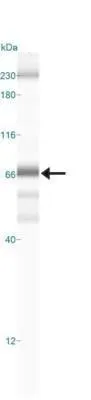
WB analysis of HeLa cell lysate using GTX13594 NFkB p65 antibody [112A1021].
| Manufacturer: | GeneTex |
| Preservative: | 0.02% Sodium azide|0.02% Sodium azide |
| Molecular Weight: | 60 |
| Physical state: | Liquid |
| Type: | Monoclonal Primary Antibody - Unconjugated |
| Alias: | RELA proto-oncogene, NF-kB subunit , CMCU , NFKB3 , p65 |
| Shipping Condition: | Blue Ice |
| Unit(s): | 100 ug |
| Host name: | Mouse |
| Clone: | 112A1021 |
| Isotype: | IgG1 |
| Immunogen: | This NfkB p65 antibody was raised against a synthetic peptide corresponding to amino acids 526-539 of human NF-kB (p65) protein. |
| Application: | FC, IHC-P, WB, MS |
Description
Description: NFKB1 (MIM 164011) or NFKB2 (MIM 164012) is bound to REL (MIM 164910), RELA, or RELB (MIM 604758) to form the NFKB complex. The p50 (NFKB1)/p65 (RELA) heterodimer is the most abundant form of NFKB. The NFKB complex is inhibited by I-kappa-B proteins (NFKBIA, MIM 164008 or NFKBIB, MIM 604495), which inactivate NFKB by trapping it in the cytoplasm. Phosphorylation of serine residues on the I-kappa-B proteins by kinases (IKBKA, MIM 600664, or IKBKB, MIM 603258) marks them for destruction via the ubiquitination pathway, thereby allowing activation of the NFKB complex. Activated NFKB complex translocates into the nucleus and binds DNA at kappa-B-binding motifs such as 5-prime GGGRNNYYCC 3-prime or 5-prime HGGARNYYCC 3-prime (where H is A, C, or T; R is an A or G purine; and Y is a C or T pyrimidine).[supplied by OMIM]
Additional Text
Gene Name
RELA
Gene ID
5970
Uniprot ID
Q04206
Purification
Protein G purified
Molecular Weight
60
Antibody Clonality
Monoclonal
Note
For In vitro laboratory use only. Not for any clinical, therapeutic, or diagnostic use in humans or animals. Not for animal or human consumption
Concentration
1 mg/ml
Storage Note
Store as concentrated solution. Centrifuge briefly prior to opening vial. For short-term storage (1-2 weeks), store at 4C. For long-term storage, aliquot and store at -20C or below. Avoid multiple freeze-thaw cycles.
Application Notes
WB: 2 - 5 µg/ml. IHC-P: 5 µg/ml. FCM: 0.25 - 0.5 µg / 10⁶ cells. *Optimal dilutions/concentrations should be determined by the researcher.Not tested in other applications.
 GTX13594 Datasheet
SUPPORT
outstanding technical support

PRODUCT
we offer a full product guarantee

DELIVERY
we offer free delivery to UK universities and non profit organisations