TCR gamma + delta antibody [5A6.E91] (FITC)
Catalogue Number: GTX15596-GTX
| Manufacturer: | GeneTex |
| Preservative: | 0.1% Sodium azide |
| Physical state: | Liquid |
| Type: | Monoclonal Primary Antibody - Conjugated |
| Alias: | T cell receptor delta locus , T cell receptor gamma locus , TCRD , TCRDV1 , TRD@ , TCRG , TRG@ |
| Shipping Condition: | Blue Ice |
| Unit(s): | 100 tests |
| Host name: | Mouse |
| Clone: | 5A6.E91 |
| Isotype: | IgG1 |
| Immunogen: | Pan TCR gamma delta |
| Application: | ELISA, FC, ICC, IF, IHC, NT, Inh |
Description
Description: T cell receptors recognize foreign antigens which have been processed as small peptides and bound to major histocompatibility complex (MHC) molecules at the surface of antigen presenting cells (APC). Each T cell receptor is a dimer consisting of one alpha and one beta chain or one delta and one gamma chain. In a single cell, the T cell receptor loci are rearranged and expressed in the order delta, gamma, beta, and alpha. If both delta and gamma rearrangements produce functional chains, the cell expresses delta and gamma. If not, the cell proceeds to rearrange the beta and alpha loci. This region represents the germline organization of the T cell receptor gamma locus. The gamma locus includes V (variable), J (joining), and C (constant) segments. During T cell development, the gamma chain is synthesized by a recombination event at the DNA level joining a V segment with a J segment; the C segment is later joined by splicing at the RNA level. Recombination of many different V segments with several J segments provides a wide range of antigen recognition. Additional diversity is attained by junctional diversity, resulting from the random addition of nucleotides by terminal deoxynucleotidyltransferase. Several V segments of the gamma locus are known to be incapable of encoding a protein and are considered pseudogenes. Somatic rearrangement of the gamma locus has been observed in T cells derived from patients with T cell leukemia and ataxia telangiectasia. [provided by RefSeq]
Additional Text
Concentration
0.1 mg/ml
Gene ID
6964
Purification
Protein A purified
Gene Name
TRD
Antibody Clonality
Monoclonal
Note
For In vitro laboratory use only. Not for any clinical, therapeutic, or diagnostic use in humans or animals. Not for animal or human consumption
Storage Note
Store as concentrated solution. Centrifuge briefly prior to opening vial. Store at 4C. Protect from light.
Application Notes
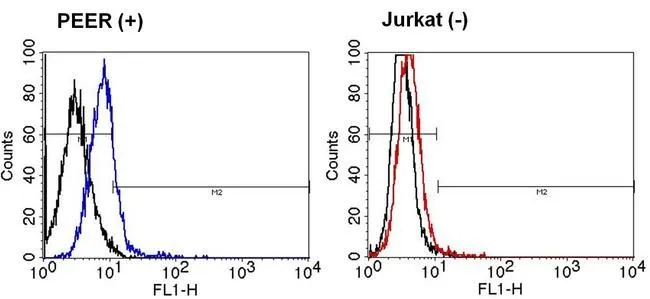
FCM: 1-2 µg/test. *Optimal dilutions/concentrations should be determined by the researcher.Not tested in other applications.
 GTX15596 Datasheet
SUPPORT
outstanding technical support

PRODUCT
we offer a full product guarantee

DELIVERY
we offer free delivery to UK universities and non profit organisations