FANCD2 antibody [FI-17]
Catalogue Number: GTX25360-GTX
GTX25360 Image

GTX25360 Image
GTX25360 Image
GTX25360 Image
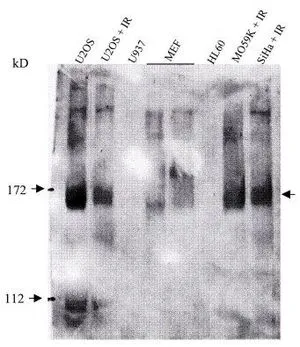
WB analysis of multiple cells treated with 10-Gy IR using GTX25360 FANCD2 antibody [FI-17]. Dilution : 1:1000
GTX25360 Image
WB analysis of HeLa cell lysate using GTX25360 FANCD2 antibody [FI-17].
GTX25360 Image
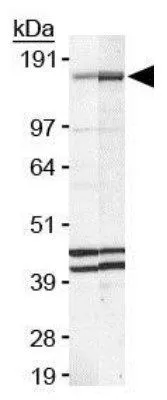
WB analysis of MCF-7 (lane 1) and HeLa (lane 2) cell lysate using GTX25360 FANCD2 antibody [FI-17].
| Manufacturer: | GeneTex |
| Preservative: | 0.1% Sodium azide |
| Molecular Weight: | 164 |
| Physical state: | Liquid |
| Type: | Monoclonal Primary Antibody - Unconjugated |
| Alias: | FA complementation group D2 , FA-D2 , FA4 , FACD , FAD , FAD2 , FANCD |
| Shipping Condition: | Blue Ice |
| Unit(s): | 100 ul |
| Host name: | Mouse |
| Clone: | FI-17 |
| Isotype: | IgG1 |
| Immunogen: | Human FANCD2 fusion protein [Swiss-Prot# Q9BXW9] |
| Application: | IP, ChIP, WB |
Description
Description: The Fanconi anemia complementation group (FANC) currently includes FANCA, FANCB, FANCC, FANCD1 (also called BRCA2), FANCD2, FANCE, FANCF, FANCG, FANCI, FANCJ (also called BRIP1), FANCL, FANCM and FANCN (also called PALB2). The previously defined group FANCH is the same as FANCA. Fanconi anemia is a genetically heterogeneous recessive disorder characterized by cytogenetic instability, hypersensitivity to DNA crosslinking agents, increased chromosomal breakage, and defective DNA repair. The members of the Fanconi anemia complementation group do not share sequence similarity; they are related by their assembly into a common nuclear protein complex. This gene encodes the protein for complementation group D2. This protein is monoubiquinated in response to DNA damage, resulting in its localization to nuclear foci with other proteins (BRCA1 AND BRCA2) involved in homology-directed DNA repair. Alternative splicing results in two transcript variants encoding different isoforms. [provided by RefSeq]
Additional Text
Gene ID
2177
Gene Name
FANCD2
Uniprot ID
Q9BXW9
Molecular Weight
164
Purification
Unpurified
Antibody Clonality
Monoclonal
Note
For In vitro laboratory use only. Not for any clinical, therapeutic, or diagnostic use in humans or animals. Not for animal or human consumption
Application Notes
WB: 1:1000 - 1:2000. ChIP assay: 1:10 - 1:500. *Optimal dilutions/concentrations should be determined by the researcher.Not tested in other applications.
Storage Note
Store as concentrated solution. Centrifuge briefly prior to opening vial. For short-term storage (1-2 weeks), store at 4C. For long-term storage, aliquot and store at -20C or below. Avoid multiple freeze-thaw cycles.
 GTX25360 Datasheet
SUPPORT
outstanding technical support

PRODUCT
we offer a full product guarantee

DELIVERY
we offer free delivery to UK universities and non profit organisations