pan Cytokeratin antibody [PCK-26]
Catalogue Number: GTX26401-GTX
GTX26401 Image
GTX26401 Image
GTX26401 Image
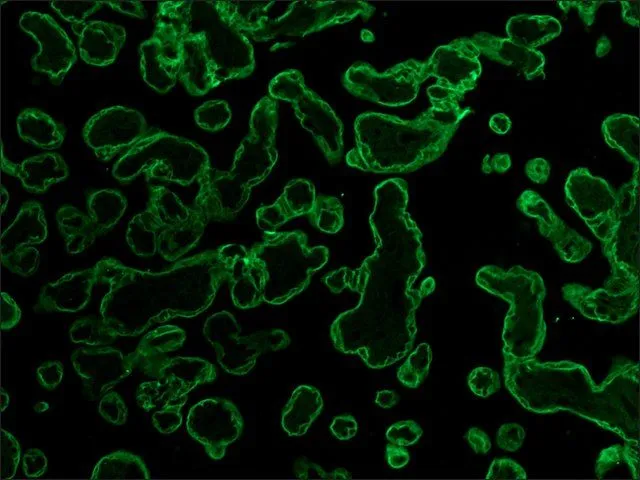
IHC-P analysis of human placenta sections using GTX26401 pan Cytokeratin antibody [PCK-26] at 1:300.
GTX26401 Image
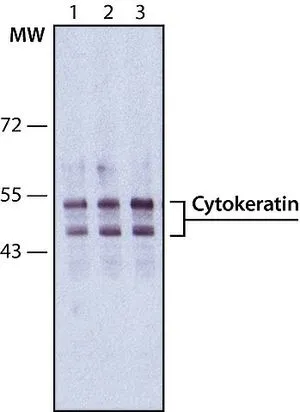
WB analysis of HeLa cell lysate using GTX26401 pan Cytokeratin antibody[PCK-26]. Lane 1 : Antibody dilution 1:300 Lane 2 : Antibody dilution 1:500 Lane 3 : Antibody dilution 1:1000.
| Manufacturer: | GeneTex |
| Preservative: | 15 mM Sodium azide |
| Physical state: | Liquid |
| Type: | Monoclonal Primary Antibody - Unconjugated |
| Shipping Condition: | Blue Ice |
| Unit(s): | 100 ul |
| Host name: | Mouse |
| Clone: | PCK-26 |
| Isotype: | IgG1 |
| Immunogen: | cytokeratin from human epidermis. |
| Application: | FC, ICC, IF, IHC-P, WB, IHC-Fr, DB, IHC, Multiplex, Blk |
Description
Description: Cytokeratins, a group comprising at least 29 different proteins, are characteristic of epithelial and trichocytic cells. Cytokeratin 5, 6 and 8 are members of the type II neutral-to-basic subfamily. Monoclonal antibodies to cytokeratins are specific markers of epithelial cell differentiation and have been widely used as tools in tumor identification and classification. PCK-26 facilitates the typing of normal, metaplastic and neoplastic cells and it may aid in the discrimination of carcinomas and non-epithelial tumors such as sarcomas, lymphomas and neural tumors. It is also useful in detecting micro-metastases in lymph nodes and other tissues and for determining the origin of poorly differentiated tumors (1,2).
Additional Text
Purification
Unpurified
Antibody Clonality
Monoclonal
Note
For In vitro laboratory use only. Not for any clinical, therapeutic, or diagnostic use in humans or animals. Not for animal or human consumption
Application Notes
IHC-P: 1:300. *Optimal dilutions/concentrations should be determined by the researcher.Not tested in other applications.
Short Description
Pan-Cytokeratin antibody [PCK-26] is a mouse monoclonal antibody that detects multiple cytokeratins (i.e., Type II cytokeratins 1, 5, 6, and 8), a group of intermediate filament proteins present in most human epithelial tissues. This reagent is a broad spectrum antibody that reacts with a variety of normal, reactive, and neoplastic epithelial tissues, as well as simple, cornifying, and non-cornifying squamous epithelia and pseudostratified epithelia.
Storage Note
Store as concentrated solution. Centrifuge briefly prior to opening vial. For short-term storage (1-2 weeks), store at 4C. For long-term storage, aliquot and store at -20C or below. Avoid multiple freeze-thaw cycles.
 GTX26401 Datasheet
SUPPORT
outstanding technical support

PRODUCT
we offer a full product guarantee

DELIVERY
we offer free delivery to UK universities and non profit organisations