NFYA antibody
Catalogue Number: GTX26558-GTX
GTX26558 Image
GTX26558 Image
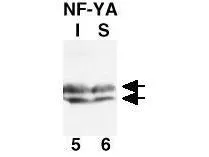
Western Blot of Rabbit Anti-NF-Y(A subunit) Antibody. Lane 1: CHO-7 cells in the absence (I) of cholesterol. Lane 2: CHO-7 cells in the presence (S) of cholesterol. Load: Equivalent aliquots of chromatin from each sample containing ~50 µg of total protein per lane. Primary antibody: anti-NF-YA antibody at 1:1000 for overnight at 4oC. Secondary antibody: HRP conjugated Goat-anti-Rabbit IgG [H&L] secondary antibody at 1:10,000 for 45 min at RT. Predicted/Observed size: doublet of ~ 42 kDa for NF-Y A.
| Manufacturer: | GeneTex |
| Preservative: | 0.01% Sodium azide |
| Molecular Weight: | 37 |
| Physical state: | Liquid |
| Type: | Polyclonal Primary Antibody - Unconjugated |
| Alias: | nuclear transcription factor Y subunit alpha , CBF-A , CBF-B , HAP2 , NF-YA |
| Shipping Condition: | Blue Ice |
| Unit(s): | 100 ug |
| Host name: | Rabbit |
| Clone: | |
| Isotype: | IgG |
| Immunogen: | Synthetic NF-Y (A subunit) peptide corresponding to a region near the N-terminus of the human protein conjugated to KLH. |
| Application: | ELISA, ChIP, WB, EMSA |
Description
Description: The Y box is a CCAAT box that is bound by the heteromeric DNA binding protein, NF-Y (also known as CBF and CP1). Unlike the transcription factors C/EBP and CTF/NF1, which also bind CCAAT-like sequences, NF-Y exhibits a strict binding requirement for this pentanucleotide sequence. Binding sites for this factor have been described for nearly 30% of all eukaryotic genes. Y/CCAAT sequences were frequently observed in the promoter-proximal sequences. NF-Y is composed of 3 separate subunits (A, B and C) each of which is required for DNA binding. Each subunit has remained highly conserved throughout evolution. In fact, homologous yeast subunits can substitute for mammalian NF-Y in DNA-binding assays. The conserved core sequences of NF-YB and NF-YC contain a 70 aa region similar to the histone fold motif of nucleosomes H2A and H2B. The unique structure and evolutionary conservation of this transcription factor suggests that it plays a fundamental role in the readout of eukaryotic genetic information.
Additional Text
Gene ID
4800
Gene Name
NFYA
Concentration
0.6 mg/ml
Molecular Weight
37
Uniprot ID
P23511
Antibody Clonality
Polyclonal
Note
For In vitro laboratory use only. Not for any clinical, therapeutic, or diagnostic use in humans or animals. Not for animal or human consumption
Application Notes
WB: 1:1000. ELISA: 1:10000. *Optimal dilutions/concentrations should be determined by the researcher.Not tested in other applications.
Storage Note
Store as concentrated solution. Centrifuge briefly prior to opening vial. For short-term storage (1-2 weeks), store at 4C. For long-term storage, aliquot and store at -20C or below. Avoid multiple freeze-thaw cycles.
 GTX26558 Datasheet
SUPPORT
outstanding technical support

PRODUCT
we offer a full product guarantee

DELIVERY
we offer free delivery to UK universities and non profit organisations