NFkB p105/p50 antibody
Catalogue Number: GTX27549-GTX
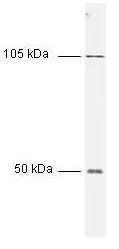
GTX27549 Image
GTX27549 Image
Western blot of HeLa cell extract.? The membrane was blocked in 5% dry milk for 2 h.? After washing, a:1:1,000 dilution of the primary antibody was added to the membrane and incubated for 2 h.? Washes with buffer were performed 4 times for 5' each.? The western blot was incubated with secondary antibody (HRP Goat-a-Rabbit IgG [H&L]) diluted 1:2,000 for 1 h.?? Washes with TBS preceded color development.
| Manufacturer: | GeneTex |
| Preservative: | 0.01% Sodium azide |
| Molecular Weight: | 105 |
| Physical state: | Liquid |
| Type: | Polyclonal Primary Antibody - Unconjugated |
| Alias: | nuclear factor kappa B subunit 1 , CVID12 , EBP-1 , KBF1 , NF-kB1 , NF-kappa-B1 , NF-kappaB , NFKB-p105 , NFKB-p50 , NFkappaB , p105 , p50 |
| Shipping Condition: | Blue Ice |
| Unit(s): | 100 ul |
| Host name: | Rabbit |
| Clone: | |
| Isotype: | IgG |
| Immunogen: | Human NFkB p50 (NFKB1) peptide corresponding to a region near the N-terminus of the human protein conjugated to KLH. |
| Application: | ELISA, WB, EMSA |
Description
Description: The transcription factor NFkB is widely recognized as a critical mediator of immune and inflammatory responses. In most cell types, NFkB is found in the cytoplasm where it is associated with an inhibitory protein known as IkB. An impressive variety of stimuli (tumor necrosis factor, interleukin 1, T-cell activation signals, bacterial endotoxins, viral transforming proteins, certain growth factors and reactive oxygen intermediates) lead to the rapid nuclear accumulation of NFkB by the induced phosphorylation and subsequent degradation of IkB. In the nucleus, NFkB regulates genes encoding cytokines, cytokine receptors, cell adhesion molecules, proteins involved in coagulation and genes involved in cell growth control. Additionally, NFkB is thought to be an important transcriptional regulator for HIV. Growing evidence indicates that the disregulation of NFkB may be key to a number of diseases including arthritis and other inflammatory diseases, Alzheimer's disease, atherosclerosis and cancer.
Additional Text
Gene Name
NFKB1
Gene ID
4790
Uniprot ID
P19838
Purification
Unpurified
Antibody Clonality
Polyclonal
Note
For In vitro laboratory use only. Not for any clinical, therapeutic, or diagnostic use in humans or animals. Not for animal or human consumption
Molecular Weight
105
Application Notes
WB: 1:500-1:2000. ELISA: 1:5000-1:25000. EMSA: 0.5-1 µL. *Optimal dilutions/concentrations should be determined by the researcher.Not tested in other applications.
Storage Note
Store as concentrated solution. Centrifuge briefly prior to opening vial. For short-term storage (1-2 weeks), store at 4C. For long-term storage, aliquot and store at -20C or below. Avoid multiple freeze-thaw cycles.
 GTX27549 Datasheet
SUPPORT
outstanding technical support

PRODUCT
we offer a full product guarantee

DELIVERY
we offer free delivery to UK universities and non profit organisations