Elastase 3B antibody [CELA3B/1757]
Catalogue Number: GTX34688-GTX
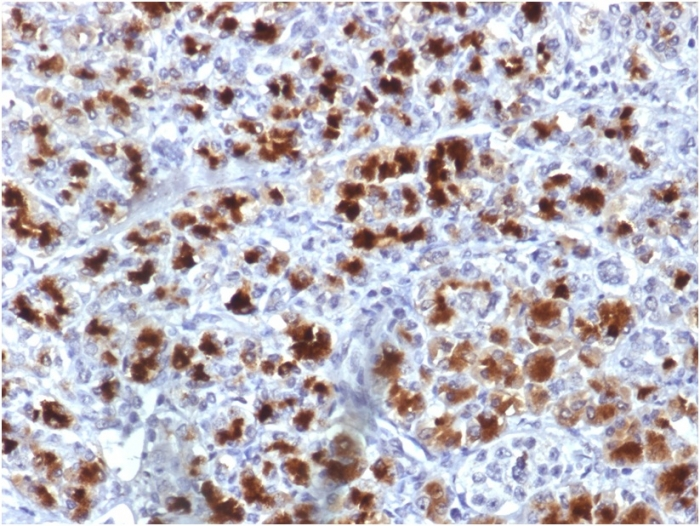
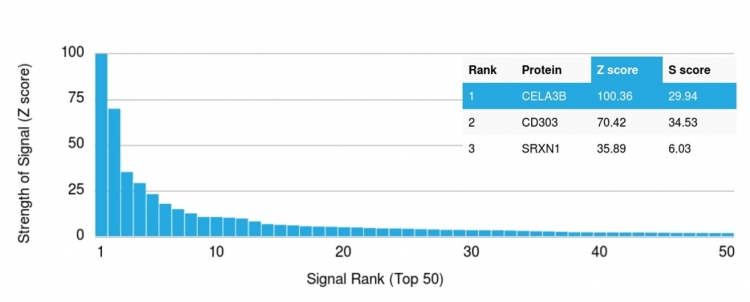
| Manufacturer: | GeneTex |
| Preservative: | 0.05% Sodium azide|0.05% Sodium azide |
| Molecular Weight: | 29 |
| Physical state: | Liquid |
| Type: | Monoclonal Primary Antibody - Unconjugated |
| Alias: | CBPP , CELA3B , ELA3B , chymotrypsin like elastase family member 3B , Elastase 3B , chymotrypsin like elastase 3B |
| Shipping Condition: | Blue Ice |
| Unit(s): | 100 ug |
| Host name: | Mouse |
| Clone: | CELA3B/1757 |
| Isotype: | IgG2b |
| Immunogen: | Recombinant fragment (around aa 82-238) of human CELA3B protein (exact sequence is proprietary) |
| Application: | ELISA, IHC-P, PA |
Description
Description: Elastases form a subfamily of serine proteases that hydrolyze many proteins in addition to elastin. Humans have six elastase genes which encode the structurally similar proteins elastase 1, 2, 2A, 2B, 3A, and 3B. Unlike other elastases, elastase 3B has little elastolytic activity. Like most of the human elastases, elastase 3B is secreted from the pancreas as a zymogen and, like other serine proteases such as trypsin, chymotrypsin and kallikrein, it has a digestive function in the intestine. Elastase 3B preferentially cleaves proteins after alanine residues. Elastase 3B may also function in the intestinal transport and metabolism of cholesterol. Both elastase 3A and elastase 3B have been referred to as protease E and as elastase 1, and excretion of this protein in fecal material is frequently used as a measure of pancreatic function in clinical assays. [provided by RefSeq, May 2009]
Additional Text
Purification
Protein A/G Purified
Gene ID
23436
Gene Name
CELA3B
Concentration
0.2 mg/ml
Uniprot ID
P08861
Antibody Clonality
Monoclonal
Note
For In vitro laboratory use only. Not for any clinical, therapeutic, or diagnostic use in humans or animals. Not for animal or human consumption
Application Notes
IHC-P: 1-2µg/ml for 30 minutes at RT. ELISA: 2-4µg/ml (for coating). *Optimal dilutions/concentrations should be determined by the researcher.Not tested in other applications.
Storage Note
Store as concentrated solution. Centrifuge briefly prior to opening vial. For short-term storage (1-2 weeks), store at 4C. For long-term storage, aliquot and store at -20C or below. Avoid multiple freeze-thaw cycles.
 GTX34688 Datasheet
SUPPORT
outstanding technical support

PRODUCT
we offer a full product guarantee

DELIVERY
we offer free delivery to UK universities and non profit organisations