p63 antibody [TP63/1786]
Catalogue Number: GTX34944-GTX
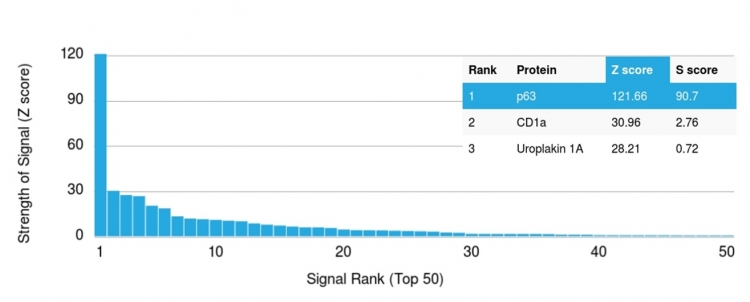
GTX34944 Image
GTX34944 Image
GTX34944 Image
GTX34944 Image
GTX34944 Image
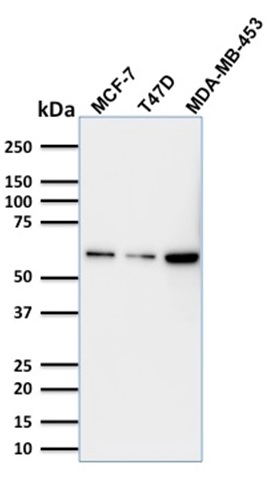
WB analysis of MCF-7, T47D, and MDA-MB453 cell lysates using GTX34944 p63 antibody [TP63/1786].
GTX34944 Image
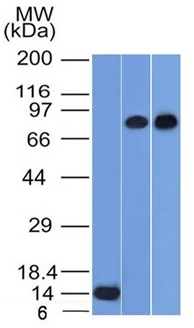
WB analysis of recombinant p63 protein, PC3, and HeLa cell lysates using GTX34944 p63 antibody [TP63/1786].
| Manufacturer: | GeneTex |
| Preservative: | 0.05% Sodium azide|0.05% Sodium azide |
| Molecular Weight: | 77 |
| Physical state: | Liquid |
| Type: | Monoclonal Primary Antibody - Unconjugated |
| Alias: | AIS , B(p51A) , B(p51B) , EEC3 , KET , LMS , NBP , OFC8 , RHS , SHFM4 , TP53CP , TP53L , TP63 , TP73L , p40 , p51 , p53CP , p63 , p73H , p73L , tumor protein p63 |
| Shipping Condition: | Blue Ice |
| Unit(s): | 100 ug |
| Host name: | Mouse |
| Clone: | TP63/1786 |
| Isotype: | IgG2b |
| Immunogen: | Recombinant fragment (around aa 3-106) of human p63 protein (exact sequence is proprietary) |
| Application: | ELISA, WB, PA |
Description
Description: This gene encodes a member of the p53 family of transcription factors. The functional domains of p53 family proteins include an N-terminal transactivation domain, a central DNA-binding domain and an oligomerization domain. Alternative splicing of this gene and the use of alternative promoters results in multiple transcript variants encoding different isoforms that vary in their functional properties. These isoforms function during skin development and maintenance, adult stem/progenitor cell regulation, heart development and premature aging. Some isoforms have been found to protect the germline by eliminating oocytes or testicular germ cells that have suffered DNA damage. Mutations in this gene are associated with ectodermal dysplasia, and cleft lip/palate syndrome 3 (EEC3); split-hand/foot malformation 4 (SHFM4); ankyloblepharon-ectodermal defects-cleft lip/palate; ADULT syndrome (acro-dermato-ungual-lacrimal-tooth); limb-mammary syndrome; Rap-Hodgkin syndrome (RHS); and orofacial cleft 8. [provided by RefSeq, Aug 2016]
Additional Text
Gene Name
TP63
Gene ID
8626
Uniprot ID
Q9H3D4
Purification
Protein A/G Purified
Concentration
0.2 mg/ml
Molecular Weight
77
Antibody Clonality
Monoclonal
Note
For In vitro laboratory use only. Not for any clinical, therapeutic, or diagnostic use in humans or animals. Not for animal or human consumption
Application Notes
WB: 1-2µg/ml. *Optimal dilutions/concentrations should be determined by the researcher.Not tested in other applications.
Storage Note
Store as concentrated solution. Centrifuge briefly prior to opening vial. For short-term storage (1-2 weeks), store at 4C. For long-term storage, aliquot and store at -20C or below. Avoid multiple freeze-thaw cycles.
 GTX34944 Datasheet
SUPPORT
outstanding technical support

PRODUCT
we offer a full product guarantee

DELIVERY
we offer free delivery to UK universities and non profit organisations