AHA-1 antibody [25F2.D9]
Catalogue Number: GTX48775-GTX
GTX48775 Image
GTX48775 Image
GTX48775 Image
GTX48775 Image
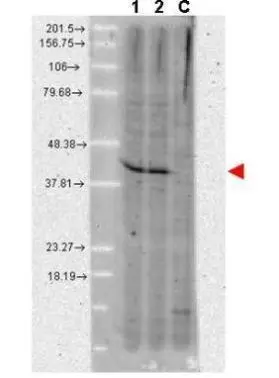
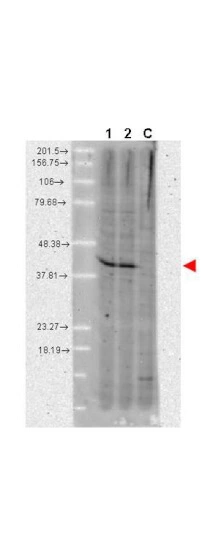
Western blot using GeneTex's anti-AHA1 monoclonal antibody shows detection of a band ~42 kDa in size corresponding to AHA1 in A431 whole cell lysate (lane 1) and MCF-7 whole cell lysate (lane 2). A control lane is shown where primary ahntibody was omitted from the incubation (lane C). Molecular weight markers are shown at the left. For best results, block the membrane overnight with 3% BSA in TBS followed by reaction with primary antibody diluted 1:1,000 and use HRP conjugated anti-Rabbit IgG secondary antibody diluted 1:20,000 in blocking buffer) for detection.
GTX48775 Image
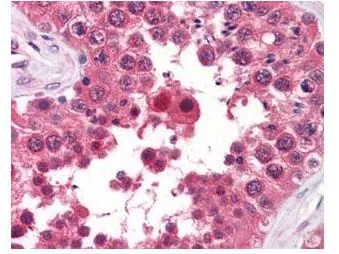
GeneTex's anti-AHA1 monoclonal antibody was used at a 5-10 µg/mL to detect AHA1 in the seminiferous tubule of human testis (40X) showing moderate staining. Leydig cells showed faint to moderate staining. Expression of AHA1 is reported in many epithelial and lymphatic tissues, with cytoplasmic localization. This antibody showed moderate cytoplasmic staining of a variety of epithelial tissues and lymphoid organs such as spleen and tonsil with minimal background staining. The image shows the localization of the antibody as the precipitated red signal, with a hematoxylin purple nuclear counterstain. Tissue was formalin-fixed and paraffin embedded.
GTX48775 Image
WB analysis of various samples using GTX48775 AHA-1 antibody [25F2.D9]. Lane 1 : A431 whole cell lysate Lane 2 : MCF-7 whole cell lysate Lane C : Without primary antibody Dilution : 1:1000
| Manufacturer: | GeneTex |
| Preservative: | no preservative|No preservative |
| Molecular Weight: | 38 |
| Physical state: | Liquid |
| Type: | Monoclonal Primary Antibody - Unconjugated |
| Alias: | AHA1, activator of heat shock protein ATPase 1 , BC023857 , p38 |
| Shipping Condition: | Blue Ice |
| Unit(s): | 50 ug |
| Host name: | Rat |
| Clone: | 25F2.D9 |
| Isotype: | IgG2a |
| Immunogen: | Full length recombinant mouse AHA1 protein followed by hybridoma development. |
| Application: | ELISA, IHC-P, WB |
Description
Description: Activator of Hsp90 ATPase (AHA1) stimulates the inherent ATPase cycle of Hsp90, which is essential for its chaperone activity in vivo. The activation and/or stability of many of the key regulatory and signaling proteins of the eukaryotic cell depend on their interaction with the Hsp90 molecular chaperone. Hsp90 is assisted and regulated by co-chaperones that participate in an ordered series both to assist client-protein recruitment or release and to modulate progress through the ATPase coupled chaperone cycle. Structural analysis and mutagenesis show that binding of the N-terminal domain of AHA1 to Hsp90 promotes a conformational switch in the middle-segment catalytic loop (aa 370-390) of Hsp90 that exposes the catalytic Arg380 and enables its interaction with ATP in the N-terminal nucleotide-binding domain of the chaperone. Recent studies show that AHA1 modulates Hsp90-dependent stability of the folding of the cystic fibrosis transmembrane conductance regulator (CFTR) in the endoplasmic reticulum (ER). Down-regulation of AHA1 rescues misfolding of CFTR in cystic fibrosis.
Additional Text
Gene Name
AHSA1
Uniprot ID
Q8BK64
Gene ID
217737
Antibody Clonality
Monoclonal
Note
For In vitro laboratory use only. Not for any clinical, therapeutic, or diagnostic use in humans or animals. Not for animal or human consumption
Molecular Weight
38
Concentration
1 mg/ml
Application Notes
WB: 1:1000. IHC-P: 5-10 µg/mL. ELISA: 1:20000. *Optimal dilutions/concentrations should be determined by the researcher.Not tested in other applications.
Storage Note
Store as concentrated solution. Centrifuge briefly prior to opening vial. For short-term storage (1-2 weeks), store at 4C. For long-term storage, aliquot and store at -20C or below. Avoid multiple freeze-thaw cycles.
 GTX48775 Datasheet
SUPPORT
outstanding technical support

PRODUCT
we offer a full product guarantee

DELIVERY
we offer free delivery to UK universities and non profit organisations