KIR3DL1 antibody
Catalogue Number: GTX54325-GTX
| Manufacturer: | GeneTex |
| Preservative: | 0.02% Sodium azide|0.02% Sodium azide |
| Molecular Weight: | 49 |
| Physical state: | Liquid |
| Type: | Polyclonal Primary Antibody - Unconjugated |
| Alias: | killer cell immunoglobulin like receptor, three Ig domains and long cytoplasmic tail 1 , CD158E1 , KIR , KIR3DL1/S1 , NKAT-3 , NKAT3 , NKB1 , NKB1B |
| Shipping Condition: | Blue Ice |
| Unit(s): | 100 ug |
| Host name: | Rabbit |
| Clone: | |
| Isotype: | IgG |
| Immunogen: | Recombinant fusion protein containing a sequence corresponding to amino acids 22-222 of human KIR3DL1 (NP_037421.2). |
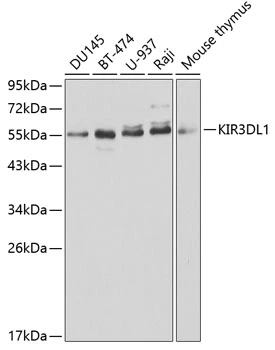
| Application: | WB |
Description
Description: Killer cell immunoglobulin-like receptors (KIRs) are transmembrane glycoproteins expressed by natural killer cells and subsets of T cells. The KIR genes are polymorphic and highly homologous and they are found in a cluster on chromosome 19q13.4 within the 1 Mb leukocyte receptor complex (LRC). The gene content of the KIR gene cluster varies among haplotypes, although several "framework" genes are found in all haplotypes (KIR3DL3, KIR3DP1, KIR3DL4, KIR3DL2). The KIR proteins are classified by the number of extracellular immunoglobulin domains (2D or 3D) and by whether they have a long (L) or short (S) cytoplasmic domain. KIR proteins with the long cytoplasmic domain transduce inhibitory signals upon ligand binding via an immune tyrosine-based inhibitory motif (ITIM), while KIR proteins with the short cytoplasmic domain lack the ITIM motif and instead associate with the TYRO protein tyrosine kinase binding protein to transduce activating signals. The ligands for several KIR proteins are subsets of HLA class I molecules; thus, KIR proteins are thought to play an important role in regulation of the immune response. [provided by RefSeq, Jul 2008]
Additional Text
Gene Name
KIR3DL1
Gene ID
3811
Uniprot ID
P43629
Purification
Affinity Purified
Molecular Weight
49
Antibody Clonality
Polyclonal
Note
For In vitro laboratory use only. Not for any clinical, therapeutic, or diagnostic use in humans or animals. Not for animal or human consumption
Application Notes
WB: 1:500 - 1:2000. *Optimal dilutions/concentrations should be determined by the researcher.Not tested in other applications.
Storage Note
Store as concentrated solution. Centrifuge briefly prior to opening vial. For short-term storage (1-2 weeks), store at 4C. For long-term storage, aliquot and store at -20C or below. Avoid multiple freeze-thaw cycles.
 GTX54325 Datasheet
SUPPORT
outstanding technical support

PRODUCT
we offer a full product guarantee

DELIVERY
we offer free delivery to UK universities and non profit organisations