KPNA2 antibody
Catalogue Number: GTX54349-GTX
GTX54349 Image
GTX54349 Image
GTX54349 Image
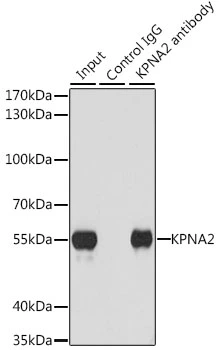
IP analysis of U-251MG cell lysate using GTX54349 KPNA2 antibody. Antibody amount : 3µg / 200µg lysate Dilution : 1:1000
GTX54349 Image
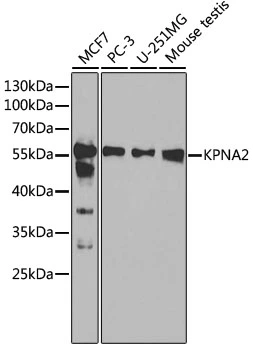
WB analysis of various sample lysates using GTX54349 KPNA2 antibody. Dilution : 1:1000 Loading : 25µg per lane
| Manufacturer: | GeneTex |
| Preservative: | 0.02% Sodium azide|0.02% Sodium azide |
| Molecular Weight: | 58 |
| Physical state: | Liquid |
| Type: | Polyclonal Primary Antibody - Unconjugated |
| Alias: | karyopherin subunit alpha 2 , IPOA1 , QIP2 , RCH1 , SRP1-alpha , SRP1alpha |
| Shipping Condition: | Blue Ice |
| Unit(s): | 100 ug |
| Host name: | Rabbit |
| Clone: | |
| Isotype: | IgG |
| Immunogen: | Recombinant fusion protein containing a sequence corresponding to amino acids 1-290 of human KPNA2 (NP_002257.1). |
| Application: | IP, WB |
Description
Description: The import of proteins into the nucleus is a process that involves at least 2 steps. The first is an energy-independent docking of the protein to the nuclear envelope and the second is an energy-dependent translocation through the nuclear pore complex. Imported proteins require a nuclear localization sequence (NLS) which generally consists of a short region of basic amino acids or 2 such regions spaced about 10 amino acids apart. Proteins involved in the first step of nuclear import have been identified in different systems. These include the Xenopus protein importin and its yeast homolog, SRP1 (a suppressor of certain temperature-sensitive mutations of RNA polymerase I in Saccharomyces cerevisiae), which bind to the NLS. KPNA2 protein interacts with the NLSs of DNA helicase Q1 and SV40 T antigen and may be involved in the nuclear transport of proteins. KPNA2 also may play a role in V(D)J recombination. Alternative splicing results in multiple transcript variants. [provided by RefSeq, Feb 2016]
Additional Text
Gene Name
KPNA2
Uniprot ID
P52292
Gene ID
3838
Purification
Affinity Purified
Molecular Weight
58
Antibody Clonality
Polyclonal
Note
For In vitro laboratory use only. Not for any clinical, therapeutic, or diagnostic use in humans or animals. Not for animal or human consumption
Application Notes
WB: 1:500 - 1:2000. IP: 1:50 - 1:100. *Optimal dilutions/concentrations should be determined by the researcher.Not tested in other applications.
Storage Note
Store as concentrated solution. Centrifuge briefly prior to opening vial. For short-term storage (1-2 weeks), store at 4C. For long-term storage, aliquot and store at -20C or below. Avoid multiple freeze-thaw cycles.
 GTX54349 Datasheet
SUPPORT
outstanding technical support

PRODUCT
we offer a full product guarantee

DELIVERY
we offer free delivery to UK universities and non profit organisations