KCNN3 antibody
Catalogue Number: GTX54779-GTX
GTX54779 Image
GTX54779 Image
GTX54779 Image
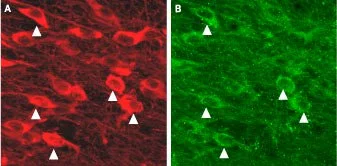
IHC-Fr analysis of mouse dopaminergic neurons tissue using GTX54779 KCNN3 antibody. Triangles point at cells with co-localization. Panel A : KCa2.3 is detected ?in ?substantia nigra pars compacta. Panel B : Tyrosine hydroxylase staining shows dopaminergic neurons.
GTX54779 Image
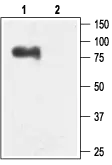
WB analysis of rat brain membrane lysate using GTX54779 KCNN3 antibody preincubated with or without immunogen peptide. Dilution : 1:200
| Manufacturer: | GeneTex |
| Preservative: | 0.05% Sodium azide|0.05% Sodium azide |
| Molecular Weight: | 81 |
| Physical state: | Liquid |
| Type: | Polyclonal Primary Antibody - Unconjugated |
| Alias: | potassium calcium-activated channel subfamily N member 3 , KCa2.3 , SK3 , SKCA3 , hSK3 |
| Shipping Condition: | Blue Ice |
| Unit(s): | 50 ul |
| Host name: | Rabbit |
| Clone: | |
| Isotype: | IgG |
| Immunogen: | Peptide DTSGHFHDSGVGDLDEDPKC, corresponding to amino acid residues 2-21 (Intracellular, N-terminus) of human KCNN3 (Accession : Q9UGI6). |
| Application: | ICC, IF, WB, IHC-Fr |
Description
Description: Action potentials in vertebrate neurons are followed by an afterhyperpolarization (AHP) that may persist for several seconds and may have profound consequences for the firing pattern of the neuron. Each component of the AHP is kinetically distinct and is mediated by different calcium-activated potassium channels. This gene belongs to the KCNN family of potassium channels. It encodes an integral membrane protein that forms a voltage-independent calcium-activated channel, which is thought to regulate neuronal excitability by contributing to the slow component of synaptic AHP. This gene contains two CAG repeat regions in the coding sequence. It was thought that expansion of one or both of these repeats could lead to an increased susceptibility to schizophrenia or bipolar disorder, but studies indicate that this is probably not the case. Alternatively spliced transcript variants encoding different isoforms have been found for this gene. [provided by RefSeq, Feb 2011]
Additional Text
Concentration
0.6 mg/ml
Gene Name
KCNN3
Uniprot ID
Q9UGI6
Gene ID
3782
Purification
Affinity Purified
Antibody Clonality
Polyclonal
Note
For In vitro laboratory use only. Not for any clinical, therapeutic, or diagnostic use in humans or animals. Not for animal or human consumption
Molecular Weight
81
Storage Note
Store as concentrated solution. Centrifuge briefly prior to opening vial. For short-term storage (1-2 weeks), store at 4C. For long-term storage, aliquot and store at -20C or below. Avoid multiple freeze-thaw cycles.
 GTX54779 Datasheet
SUPPORT
outstanding technical support

PRODUCT
we offer a full product guarantee

DELIVERY
we offer free delivery to UK universities and non profit organisations