Nectin 1 antibody
Catalogue Number: GTX54843-GTX
GTX54843 Image
GTX54843 Image
GTX54843 Image
GTX54843 Image
_396_w_23060900_120.webp)
GTX54843 Image
GTX54843 Image
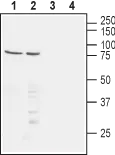
WB analysis of Jurkat (lanes 1 and 3) and MEG-01 (lanes 2 and 4) cell lysates using GTX54843 Nectin 1 antibody preincubated with or without immunogen peptide. Dilution : 1:200
GTX54843 Image
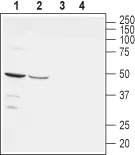
WB analysis of rat (lanes 1 and 3) and mouse (lanes 2 and 4) brain lysates using GTX54843 Nectin 1 antibody preincubated with or without immunogen peptide. Dilution : 1:200
GTX54843 Image
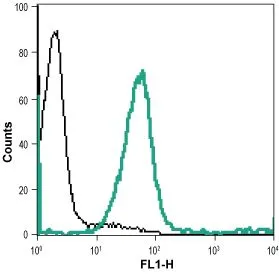
FACS analysis of THP-1 cells using GTX54843 Nectin 1 antibody. Black : Unstained cell Green : Cell staining with primary antibody Dilution : 1:15
GTX54843 Image
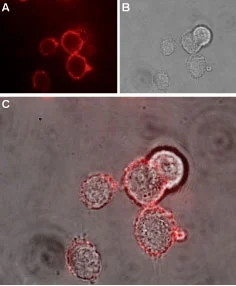
Live cell imaging analysis of live intact PC12 cells using GTX54843 Nectin 1 antibody. Panel A : Primary antibody (Red) Panel B : Live view of the cell Panel C : Merged images of Panel A and B Dilution : 1:100
GTX54843 Image
IHC-FoFr (Free Floating) analysis of rat cerebellum tissue using GTX54843 Nectin 1 antibody. Panel A: Nectin-1 staining (red) is apparent in Purkinje neurons and their dendritic tree (arrow). Panel B : Cell nuclei in the same section are visualized with DAPI (blue). Panel C : Merge of the two images. Dilution : 1:100
| Manufacturer: | GeneTex |
| Preservative: | 0.05% Sodium azide|0.05% Sodium azide |
| Molecular Weight: | 57 |
| Physical state: | Liquid |
| Type: | Polyclonal Primary Antibody - Unconjugated |
| Alias: | nectin cell adhesion molecule 1 , CD111 , CLPED1 , ED4 , HIgR , HV1S , HVEC , OFC7 , PRR , PRR1 , PVRL1 , PVRR , PVRR1 , SK-12 , nectin-1 |
| Shipping Condition: | Blue Ice |
| Unit(s): | 50 ul |
| Host name: | Rabbit |
| Clone: | |
| Isotype: | IgG |
| Immunogen: | Peptide (C)GKPPSVVSWETRLK, corresponding to amino acid residues 177-190 (Extracellular, N-terminus) of human Nectin-1 (Accession : Q15223). |
| Application: | FC, ICC, IF, WB, IHC-Fr, IHC-Flt, LCImg |
Description
Description: This gene encodes an adhesion protein that plays a role in the organization of adherens junctions and tight junctions in epithelial and endothelial cells. The protein is a calcium(2+)-independent cell-cell adhesion molecule that belongs to the immunoglobulin superfamily and has 3 extracellular immunoglobulin-like loops, a single transmembrane domain (in some isoforms), and a cytoplasmic region. This protein acts as a receptor for glycoprotein D (gD) of herpes simplex viruses 1 and 2 (HSV-1, HSV-2), and pseudorabies virus (PRV) and mediates viral entry into epithelial and neuronal cells. Mutations in this gene cause cleft lip and palate/ectodermal dysplasia 1 syndrome (CLPED1) as well as non-syndromic cleft lip with or without cleft palate (CL/P). Alternative splicing results in multiple transcript variants encoding proteins with distinct C-termini. [provided by RefSeq, Oct 2009]
Additional Text
Gene ID
5818
Uniprot ID
Q15223
Concentration
0.8 mg/ml
Purification
Affinity Purified
Molecular Weight
57
Gene Name
NECTIN1
Antibody Clonality
Polyclonal
Note
For In vitro laboratory use only. Not for any clinical, therapeutic, or diagnostic use in humans or animals. Not for animal or human consumption
Storage Note
Store as concentrated solution. Centrifuge briefly prior to opening vial. For short-term storage (1-2 weeks), store at 4C. For long-term storage, aliquot and store at -20C or below. Avoid multiple freeze-thaw cycles.
 GTX54843 Datasheet
SUPPORT
outstanding technical support

PRODUCT
we offer a full product guarantee

DELIVERY
we offer free delivery to UK universities and non profit organisations