BMPR2 antibody [3F6]
Catalogue Number: GTX60415-GTX
GTX60415 Image
GTX60415 Image
GTX60415 Image
GTX60415 Image
GTX60415 Image
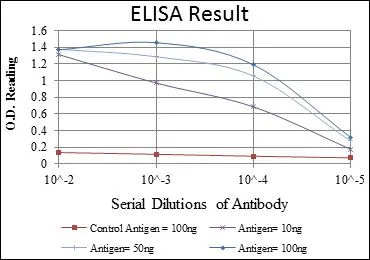
ELISA analysis of antigen using GTX60415 BMPR2 antibody [3F6]. Red : Control antigen 100ng Purple : Antigen 10ng Green : Antigen 50ng Blue : Antigen 100ng
GTX60415 Image
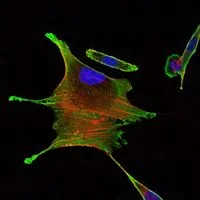
ICC/IF analysis of Eca109 cells using GTX60415 BMPR2 antibody [3F6]. Green : BMPR2 Blue: DRAQ5 fluorescent DNA dye Red: Actin filaments
GTX60415 Image
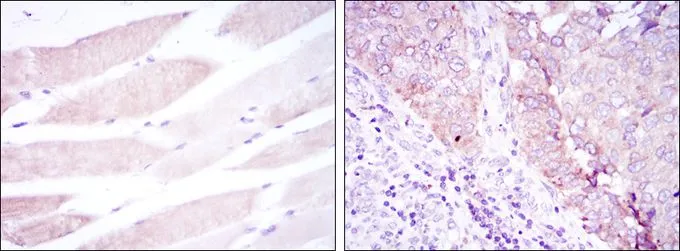
IHC-P analysis of muscle tissue (left) and kidney cancer tissue (right) using GTX60415 BMPR2 antibody [3F6].
GTX60415 Image
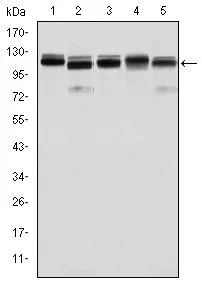
WB analysis of HeLa (1), A431 (2), NIH3T3 (3), Cos7 (4) and PC-12 (5) cell lysate using GTX60415 BMPR2 antibody [3F6].
| Manufacturer: | GeneTex |
| Preservative: | 0.03% Sodium azide |
| Molecular Weight: | 115 |
| Physical state: | Liquid |
| Type: | Monoclonal Primary Antibody - Unconjugated |
| Alias: | bone morphogenetic protein receptor type 2 , BMPR-II , BMPR3 , BMR2 , BRK-3 , POVD1 , PPH1 , T-ALK |
| Shipping Condition: | Blue Ice |
| Unit(s): | 100 ul |
| Host name: | Mouse |
| Clone: | 3F6 |
| Isotype: | IgG1 |
| Immunogen: | Purified recombinant fragment of human BMPR2 expressed in E. Coli. |
| Application: | ELISA, ICC, IF, IHC-P, WB |
Description
Description: This gene encodes a member of the bone morphogenetic protein (BMP) receptor family of transmembrane serine/threonine kinases. The ligands of this receptor are BMPs, which are members of the TGF-beta superfamily. BMPs are involved in endochondral bone formation and embryogenesis. These proteins transduce their signals through the formation of heteromeric complexes of two different types of serine (threonine) kinase receptors: type I receptors of about 50-55 kD and type II receptors of about 70-80 kD. Type II receptors bind ligands in the absence of type I receptors, but they require their respective type I receptors for signaling, whereas type I receptors require their respective type II receptors for ligand binding. Mutations in this gene have been associated with primary pulmonary hypertension, both familial and fenfluramine-associated, and with pulmonary venoocclusive disease. [provided by RefSeq, Jul 2008]
Additional Text
Gene Name
BMPR2
Uniprot ID
Q13873
Gene ID
659
Molecular Weight
115
Purification
Unpurified
Antibody Clonality
Monoclonal
Note
For In vitro laboratory use only. Not for any clinical, therapeutic, or diagnostic use in humans or animals. Not for animal or human consumption
Application Notes
WB: 1/500 - 1/2000. ICC/IF: 1/200 - 1/1000. IHC-P: 1/200 - 1/1000. ELISA: 1/10000. *Optimal dilutions/concentrations should be determined by the researcher.Not tested in other applications.
Storage Note
Store as concentrated solution. Centrifuge briefly prior to opening vial. For short-term storage (1-2 weeks), store at 4C. For long-term storage, aliquot and store at -20C or below. Avoid multiple freeze-thaw cycles.
 GTX60415 Datasheet
SUPPORT
outstanding technical support

PRODUCT
we offer a full product guarantee

DELIVERY
we offer free delivery to UK universities and non profit organisations