IDH1 antibody [GT1521]
Catalogue Number: GTX629818-GTX
GTX629818 Image
GTX629818 Image
GTX629818 Image
GTX629818 Image
GTX629818 Image
GTX629818 Image
GTX629818 Image
GTX629818 Image
GTX629818 Image
GTX629818 Image
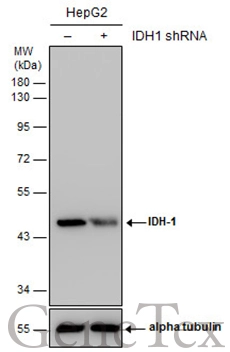
Non-transfected (-) and transfected (+) HepG2 whole cell extracts (30 µg) were separated by 10% SDS-PAGE, and the membrane was blotted with IDH1 antibody [GT1521] (GTX629818) diluted at 1:4000. The HRP-conjugated anti-mouse IgG antibody (GTX213111-01) was used to detect the primary antibody.
GTX629818 Image
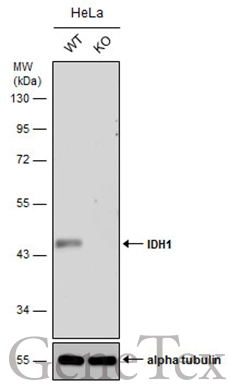
Wild-type (WT) and IDH1 knockout (KO) HeLa cell extracts (30 µg) were separated by 10% SDS-PAGE, and the membrane was blotted with IDH1 antibody [GT1521] (GTX629818) diluted at 1:500. The HRP-conjugated anti-mouse IgG antibody (GTX213111-01) was used to detect the primary antibody.
GTX629818 Image
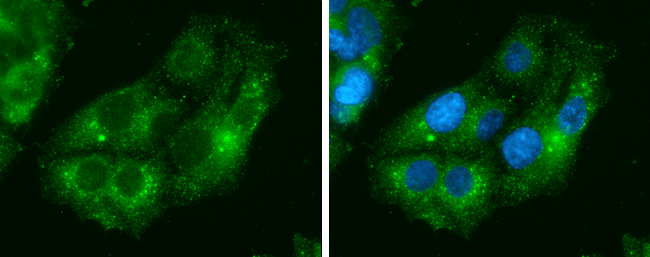
IDH1 antibody [GT1521] detects IDH1 protein at cytoplasm by immunofluorescent analysis. Sample: HepG2 cells were fixed in 4% paraformaldehyde at RT for 15 min. Green: IDH1 protein stained by IDH1 antibody [GT1521] (GTX629818) diluted at 1:500. Blue: Hoechst 33342 staining.
GTX629818 Image
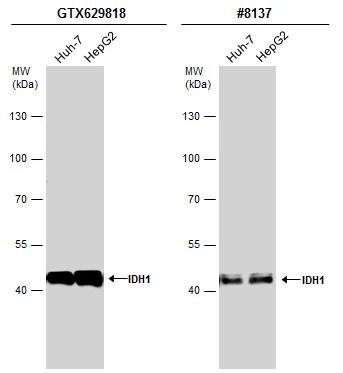
Various whole cell extracts (30 µg) were separated by 7.5% SDS-PAGE, and the membranes were blotted with IDH1 antibody [GT1521] (GTX629818) diluted at 1:1000 and competitor's antibody (CST#8137) diluted at 1:1000. The HRP-conjugated anti-mouse IgG antibody (GTX213111-01) was used to detect the primary antibody.
GTX629818 Image
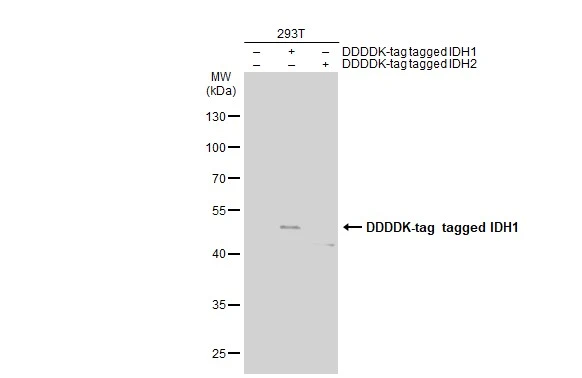
Non-transfected (-) and transfected (+) 293T whole cell extracts (30 µg) were separated by 10% SDS-PAGE, and the membrane was blotted with IDH1 antibody [GT1521] (GTX629818) diluted at 1:5000. The HRP-conjugated anti-mouse IgG antibody (GTX213111-01) was used to detect the primary antibody.
GTX629818 Image
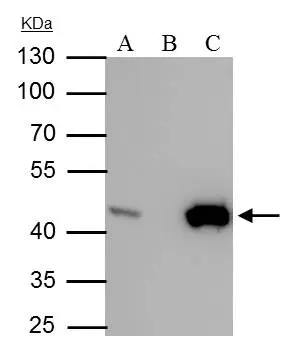
IDH-1 antibody immunoprecipitates IDH-1 protein in IP experiments. IP Sample: HepG2 whole cell lysate/extract A : 30 µg whole cell lysate/extract of IDH1 protein expressing HepG2 cells B : Control with 2.5 µg of pre-immune mouse IgG C : Immunoprecipitation of IDH-1 protein by 2.5 µg of IDH-1 antibody (GTX629818) 10% SDS-PAGE The immunoprecipitated IDH-1 protein was detected by IDH-1 antibody (GTX629818) diluted at 1 : 1000. EasyBlot anti-mouse IgG (HRP) (GTX221667-01) was used as a secondary reagent.
GTX629818 Image
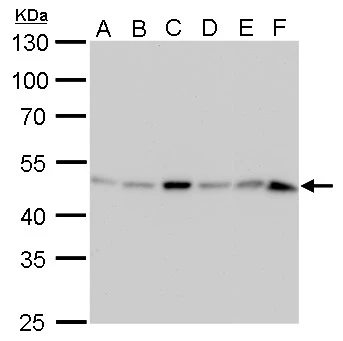
IDH1 antibody [GT1521] detects IDH1 protein by western blot analysis. A. 30 µg Neuro2A whole cell lysate/extract B. 30 µg GL261 whole cell lysate/extract C. 30 µg C8D30 whole cell lysate/extract D. 30 µg NIH-3T3 whole cell lysate/extract E. 30 µg Raw264.7 whole cell lysate/extract F. 30 µg C2C12 whole cell lysate/extract 10% SDS-PAGE IDH1 antibody [GT1521] (GTX629818) dilution: 1:1000 The HRP-conjugated anti-mouse IgG antibody (GTX213111-01) was used to detect the primary antibody.
GTX629818 Image
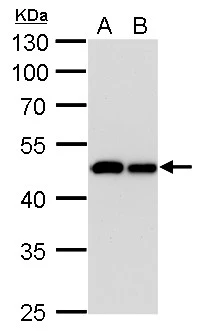
IDH1 antibody [GT1521] detects IDH1 protein by western blot analysis. A. 30 µg PC-12 whole cell lysate/extract B. 30 µg Rat-2 whole cell lysate/extract 10% SDS-PAGE IDH1 antibody [GT1521] (GTX629818) dilution: 1:1000 The HRP-conjugated anti-mouse IgG antibody (GTX213111-01) was used to detect the primary antibody.
GTX629818 Image
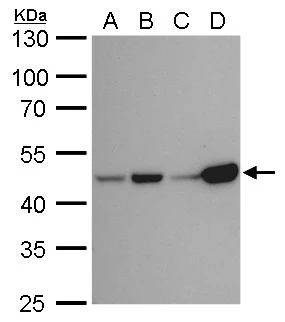
IDH1 antibody [GT1521] detects IDH1 protein by western blot analysis. A. 30 µg 293T whole cell lysate/extract B. 30 µg A431 whole cell lysate/extract C. 30 µg HeLa whole cell lysate/extract D. 30 µg HepG2 whole cell lysate/extract 10% SDS-PAGE IDH1 antibody [GT1521] (GTX629818) dilution: 1:1000 The HRP-conjugated anti-mouse IgG antibody (GTX213111-01) was used to detect the primary antibody.
| Manufacturer: | GeneTex |
| Preservative: | no preservative|No Preservative |
| Molecular Weight: | 47 |
| Physical state: | Liquid |
| Type: | Monoclonal Primary Antibody - Unconjugated |
| Alias: | isocitrate dehydrogenase (NADP(+)) 1, cytosolic , HEL-216 , HEL-S-26 , IDCD , IDH , IDP , IDPC , PICD |
| Shipping Condition: | Blue Ice |
| Unit(s): | 100 ul, 25 ul |
| Host name: | Mouse |
| Clone: | GT1521 |
| Isotype: | IgG2b |
| Immunogen: | Recombinant protein encompassing a sequence within the center region of human IDH1. The exact sequence is proprietary. |
| Application: | ICC, IF, IP, WB |
Description
Description: Isocitrate dehydrogenases catalyze the oxidative decarboxylation of isocitrate to 2-oxoglutarate. These enzymes belong to two distinct subclasses, one of which utilizes NAD(+) as the electron acceptor and the other NADP(+). Five isocitrate dehydrogenases have been reported: three NAD(+)-dependent isocitrate dehydrogenases, which localize to the mitochondrial matrix, and two NADP(+)-dependent isocitrate dehydrogenases, one of which is mitochondrial and the other predominantly cytosolic. Each NADP(+)-dependent isozyme is a homodimer. The protein encoded by this gene is the NADP(+)-dependent isocitrate dehydrogenase found in the cytoplasm and peroxisomes. It contains the PTS-1 peroxisomal targeting signal sequence. The presence of this enzyme in peroxisomes suggests roles in the regeneration of NADPH for intraperoxisomal reductions, such as the conversion of 2, 4-dienoyl-CoAs to 3-enoyl-CoAs, as well as in peroxisomal reactions that consume 2-oxoglutarate, namely the alpha-hydroxylation of phytanic acid. The cytoplasmic enzyme serves a significant role in cytoplasmic NADPH production. [provided by RefSeq]
Additional Text
Gene Name
IDH1
Purification
Protein G purified
Gene ID
3417
Molecular Weight
47
Uniprot ID
O75874
Antibody Clonality
Monoclonal
Note
For In vitro laboratory use only. Not for any clinical, therapeutic, or diagnostic use in humans or animals. Not for animal or human consumption
Concentration
1 mg/ml
Application Notes
WB: 1:500-1:10000. ICC/IF: 1:100-1:1000. IP: 1:100-1:1000. *Optimal dilutions/concentrations should be determined by the researcher.Not tested in other applications.
Storage Note
Store as concentrated solution. Centrifuge briefly prior to opening vial. For short-term storage (1-2 weeks), store at 4C. For long-term storage, aliquot and store at -20C or below. Avoid multiple freeze-thaw cycles.
 GTX629818 Datasheet
SUPPORT
outstanding technical support

PRODUCT
we offer a full product guarantee

DELIVERY
we offer free delivery to UK universities and non profit organisations