STAT3 antibody [HL1134]
Catalogue Number: GTX636400-GTX
GTX636400 Image
GTX636400 Image
GTX636400 Image
GTX636400 Image
GTX636400 Image
GTX636400 Image
GTX636400 Image
GTX636400 Image
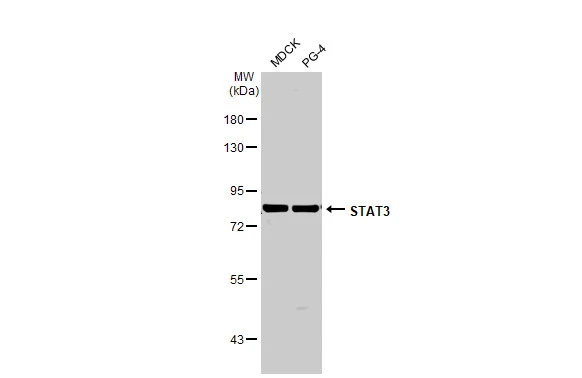
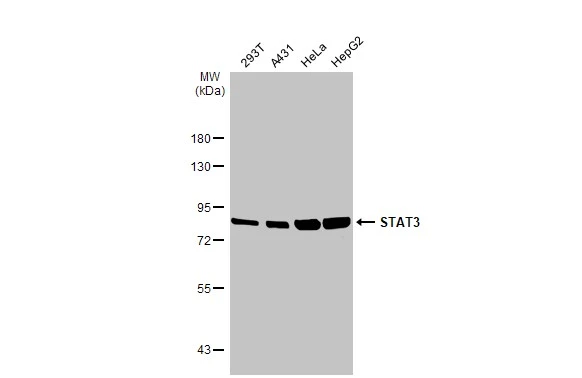
Various whole cell extracts (30 µg) were separated by 7.5% SDS-PAGE, and the membrane was blotted with STAT3 antibody [HL1134] (GTX636400) diluted at 1:1000. The HRP-conjugated anti-rabbit IgG antibody (GTX213110-01) was used to detect the primary antibody.
GTX636400 Image
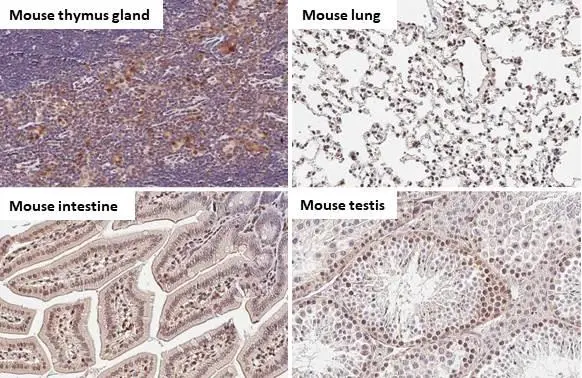
STAT3 antibody [HL1134] detects STAT3 protein at cytoplasm and nucleus by immunohistochemical analysis. Sample: Paraffin-embedded mouse tissues. STAT3 stained by STAT3 antibody [HL1134] (GTX636400) diluted at 1:100. Antigen Retrieval: Citrate buffer, pH 6.0, 15 min
GTX636400 Image
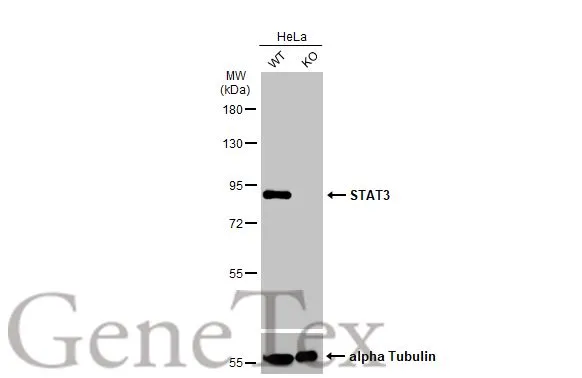
Wild-type (WT) and STAT3 knockout (KO) HeLa cell extracts (30 µg) were separated by 7.5% SDS-PAGE, and the membrane was blotted with STAT3 antibody [HL1134] (GTX636400) diluted at 1:1000. The HRP-conjugated anti-rabbit IgG antibody (GTX213110-01) was used to detect the primary antibody.
GTX636400 Image
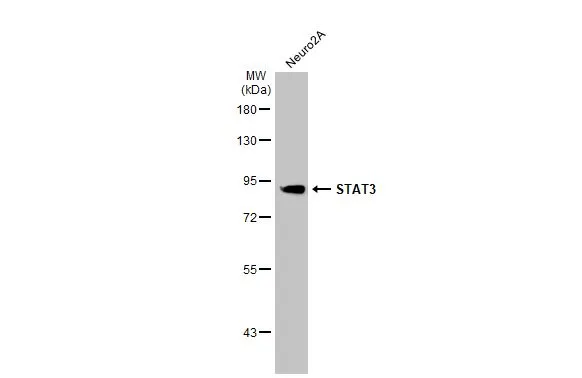
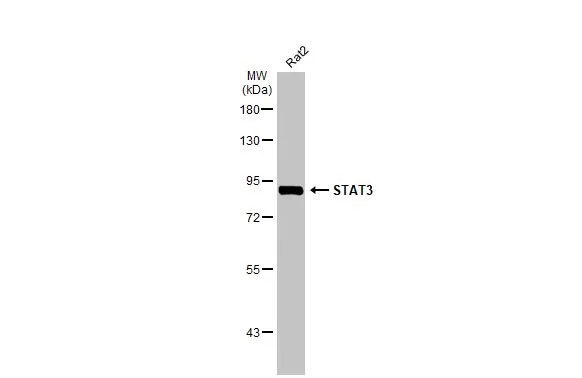
Whole cell extract (30 µg) was separated by 7.5% SDS-PAGE, and the membrane was blotted with STAT3 antibody [HL1134] (GTX636400) diluted at 1:1000. The HRP-conjugated anti-rabbit IgG antibody (GTX213110-01) was used to detect the primary antibody.
GTX636400 Image
Whole cell extract (30 µg) was separated by 7.5% SDS-PAGE, and the membrane was blotted with STAT3 antibody [HL1134] (GTX636400) diluted at 1:1000. The HRP-conjugated anti-rabbit IgG antibody (GTX213110-01) was used to detect the primary antibody.
GTX636400 Image
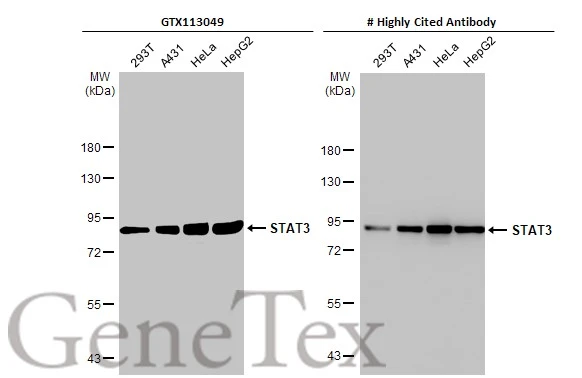
Various whole cell extracts (30 µg) were separated by 7.5% SDS-PAGE, and the membranes were blotted with STAT3 antibody [HL1134] (GTX636400) diluted at 1:1000 and competitor's antibody (#Highly competitor antibody) diluted at 1:1000. The HRP-conjugated anti-rabbit IgG antibody (GTX213110-01) was used to detect the primary antibody. *The competitor is not affiliated with GeneTex and does not endorse this product.
GTX636400 Image
Various whole cell extracts (30 µg) were separated by 7.5% SDS-PAGE, and the membrane was blotted with STAT3 antibody [HL1134] (GTX636400) diluted at 1:1000. The HRP-conjugated anti-rabbit IgG antibody (GTX213110-01) was used to detect the primary antibody.
| Manufacturer: | GeneTex |
| Preservative: | no Preservative|No Preservative |
| Molecular Weight: | 88 |
| Physical state: | Liquid |
| Type: | Recombinant Monoclonal |
| Alias: | signal transducer and activator of transcription 3 , ADMIO , ADMIO1 , APRF , HIES |
| Shipping Condition: | Blue Ice |
| Unit(s): | 100 ul, 25 ul |
| Host name: | Rabbit |
| Clone: | HL1134 |
| Isotype: | IgG |
| Immunogen: | Recombinant protein encompassing a sequence within the N-terminus region of human STAT3. The exact sequence is proprietary. |
| Application: | IHC-P, WB |
Description
Description: The protein encoded by this gene is a member of the STAT protein family. In response to cytokines and growth factors, STAT family members are phosphorylated by the receptor associated kinases, and then form homo- or heterodimers that translocate to the cell nucleus where they act as transcription activators. This protein is activated through phosphorylation in response to various cytokines and growth factors including IFNs, EGF, IL5, IL6, HGF, LIF and BMP2. This protein mediates the expression of a variety of genes in response to cell stimuli, and thus plays a key role in many cellular processes such as cell growth and apoptosis. The small GTPase Rac1 has been shown to bind and regulate the activity of this protein. PIAS3 protein is a specific inhibitor of this protein. Mutations in this gene are associated with infantile-onset multisystem autoimmune disease and hyper-immunoglobulin E syndrome. Alternative splicing results in multiple transcript variants encoding distinct isoforms. [provided by RefSeq, Sep 2015]
Additional Text
Gene Name
STAT3
Gene ID
6774
Uniprot ID
P40763
Purification
Protein A purified
Antibody Clonality
Recombinant Monoclonal
Note
For In vitro laboratory use only. Not for any clinical, therapeutic, or diagnostic use in humans or animals. Not for animal or human consumption
Concentration
1 mg/ml
Application Notes
WB: 1:500-1:3000. *Optimal dilutions/concentrations should be determined by the researcher.Not tested in other applications.
Storage Note
Store as concentrated solution. Centrifuge briefly prior to opening vial. For short-term storage (1-2 weeks), store at 4C. For long-term storage, aliquot and store at -20C or below. Avoid multiple freeze-thaw cycles.
 GTX636400 Datasheet
SUPPORT
outstanding technical support

PRODUCT
we offer a full product guarantee

DELIVERY
we offer free delivery to UK universities and non profit organisations