TLR4 antibody
Catalogue Number: GTX64330-GTX
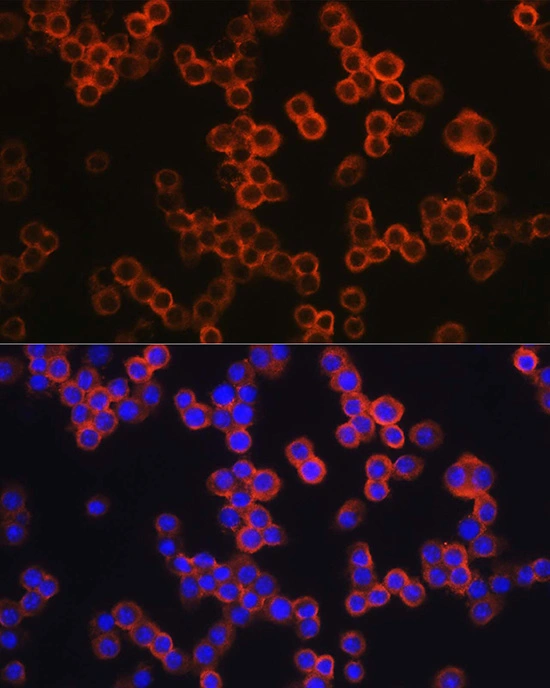
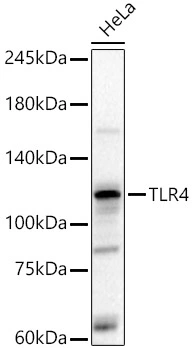
| Manufacturer: | GeneTex |
| Preservative: | 0.02% Sodium azide|0.02% Sodium azide |
| Molecular Weight: | 96 |
| Physical state: | Liquid |
| Type: | Polyclonal Primary Antibody - Unconjugated |
| Alias: | toll like receptor 4 , ARMD10 , CD284 , TLR-4 , TOLL |
| Shipping Condition: | Blue Ice |
| Unit(s): | 100 ul |
| Host name: | Rabbit |
| Clone: | |
| Isotype: | IgG |
| Immunogen: | A synthetic peptide corresponding to a sequence within amino acids 500-600 of human TLR4 (NP_612564.1). |
| Application: | ICC, IF, WB, Multiplex |
Description
Description: The protein encoded by this gene is a member of the Toll-like receptor (TLR) family which plays a fundamental role in pathogen recognition and activation of innate immunity. TLRs are highly conserved from Drosophila to humans and share structural and functional similarities. They recognize pathogen-associated molecular patterns that are expressed on infectious agents, and mediate the production of cytokines necessary for the development of effective immunity. The various TLRs exhibit different patterns of expression. This receptor has been implicated in signal transduction events induced by lipopolysaccharide (LPS) found in most gram-negative bacteria. Mutations in this gene have been associated with differences in LPS responsiveness. Multiple transcript variants encoding different isoforms have been found for this gene. [provided by RefSeq, Jan 2012]
Additional Text
Gene Name
TLR4
Gene ID
7099
Uniprot ID
O00206
Purification
Affinity Purified
Molecular Weight
96
Antibody Clonality
Polyclonal
Note
For In vitro laboratory use only. Not for any clinical, therapeutic, or diagnostic use in humans or animals. Not for animal or human consumption
Application Notes
WB: 1:500 - 1:2000. ICC/IF: 1:50 - 1:200. *Optimal dilutions/concentrations should be determined by the researcher.Not tested in other applications.
Storage Note
Store as concentrated solution. Centrifuge briefly prior to opening vial. For short-term storage (1-2 weeks), store at 4C. For long-term storage, aliquot and store at -20C or below. Avoid multiple freeze-thaw cycles.
 GTX64330 Datasheet
SUPPORT
outstanding technical support

PRODUCT
we offer a full product guarantee

DELIVERY
we offer free delivery to UK universities and non profit organisations