Human Sodium/Potassium ATPase beta 1 protein, His tag (active)
Catalogue Number: GTX67157-PRO-GTX
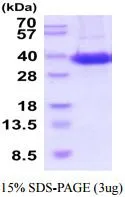
| Manufacturer: | GeneTex |
| Preservative: | no preservative|No preservative |
| Physical state: | Liquid |
| Type: | Bioactive Proteins |
| Alias: | ATPase Na+/K+ transporting subunit beta 1 , ATP1B |
| Host Cell: | Baculovirus |
| Shipping Condition: | Dry Ice |
| Unit(s): | 50 ug |
| Application: | FA |
Description
Description: The protein encoded by this gene belongs to the family of Na+/K+ and H+/K+ ATPases beta chain proteins, and to the subfamily of Na+/K+ -ATPases. Na+/K+ -ATPase is an integral membrane protein responsible for establishing and maintaining the electrochemical gradients of Na and K ions across the plasma membrane. These gradients are essential for osmoregulation, for sodium-coupled transport of a variety of organic and inorganic molecules, and for electrical excitability of nerve and muscle. This enzyme is composed of two subunits, a large catalytic subunit (alpha) and a smaller glycoprotein subunit (beta). The beta subunit regulates, through assembly of alpha/beta heterodimers, the number of sodium pumps transported to the plasma membrane. The glycoprotein subunit of Na+/K+ -ATPase is encoded by multiple genes. This gene encodes a beta 1 subunit. Alternatively spliced transcript variants encoding different isoforms have been described, but their biological validity is not known. [provided by RefSeq, Mar 2010]
Additional Text
Gene Name
ATP1B1
Concentration
0.5 mg/ml
Uniprot ID
P05026
Gene ID
481
Protein Tag
HIS Tag
Note
For In vitro laboratory use only. Not for any clinical, therapeutic, or diagnostic use in humans or animals. Not for animal or human consumption.
Application Notes
Specific activity is > 3000 pmol/min/µg, and is defined as the amount of enzyme that hydrolyze 1.0 pmole of Adenosine 5-triphosphate to phosphate per minute per minute at pH 7.5 at 25C.
Storage Note
Store as concentrated solution. Centrifuge briefly prior to opening vial. For short-term storage (1-2 weeks), store at 4C. For long-term storage, aliquot and store at -20C or below. Avoid multiple freeze-thaw cycles.
 GTX67157-PRO Datasheet
SUPPORT
outstanding technical support

PRODUCT
we offer a full product guarantee

DELIVERY
we offer free delivery to UK universities and non profit organisations