JunB antibody
Catalogue Number: GTX79258-GTX
GTX79258 Image
GTX79258 Image
GTX79258 Image
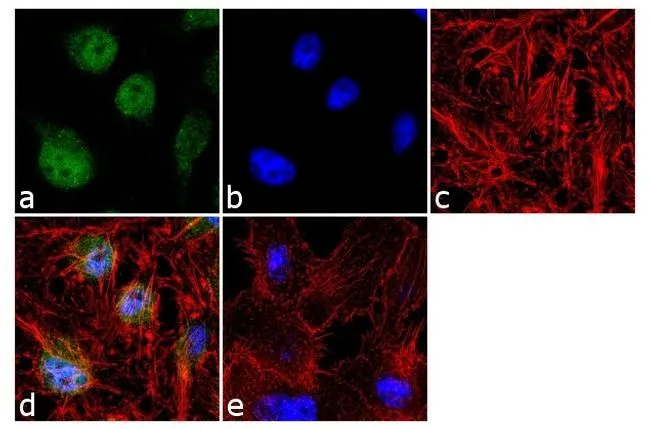
ICC/IF analysis of PC-3 cells using GTX79258 JunB antibody. Panel e is a no primary antibody control. Green : Primary antibody Blue : Nuclei Red : Actin Fixation : 4% paraformaldehyde Permeabilization : 0.1% Triton X-100 for 10 minute Dilution : 2 µg/ml in 0.1% BSA and incubated for 3 hours at room temperature
GTX79258 Image
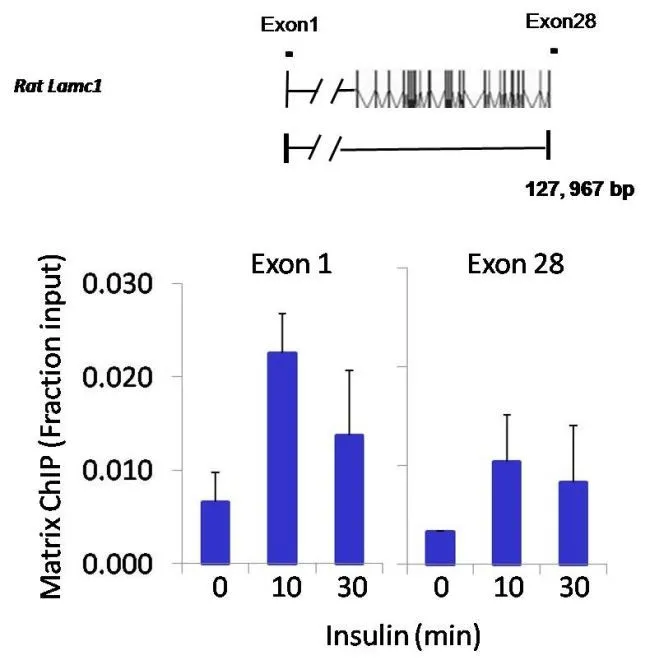
ChIP analysis of 1x10? HTC-IR rat hepatoma cells treated with insulin for 0, 10, and 30 minutes using GTX79258 JunB antibody. Immunoprecipitation was performed using a multiplex microplate Matrix ChIP assay (refer to PMID: 22098709). The precipitated DNA was detected by PCR with primer set targeting to exon-1 or exon-28 of the LAMC1 gene. IP reaction : 1.0ul antibody / 100ul sample
| Manufacturer: | GeneTex |
| Molecular Weight: | 36 |
| Physical state: | Liquid |
| Type: | Polyclonal Primary Antibody - Unconjugated |
| Alias: | jun B proto-oncogene |
| Shipping Condition: | Blue Ice |
| Unit(s): | 200 ug |
| Host name: | Rabbit |
| Clone: | |
| Isotype: | IgG |
| Immunogen: | Synthetic peptide corresponding to residues D(45) P Y R G L K G P G A R G P G P E(61) of mouse JunB. |
| Application: | FC, ICC, IF, IP, ChIP, WB |
Description
Description: Cellular oncogenes, or proto-oncogenes, play pivotal roles in cellular communication pathways that regulate normal growth, development and differentiation. The cellular oncogene families fos and jun encode nuclear proteins that can function as transcription factors. The fos family of nuclear oncogenes encode cFos, FosB, (fos-related antigen) Fra1, and Fra2. Fos and Jun dimerize to form Activator Protein-1 (AP-1), a transcriptional factor that binds to the 12-O-tetradecanoylphorbol 13-acetate (TPA) response element (TRE) of several cellular and viral genes including human collagenase, metallothionein IIa, stromelysin, interleukin 2, SV40 and polyoma. Fos and Jun contain the 'leucine-zipper' motif that allows for dimerization and an adjacent basic domain required for biological activity. The functionally active form of Fos is in a heterodimer with a member of the Jun family. While Jun family members can form functional homodimers, studies indicate that Fos family members do not self-associate and therefore do not bind DNA on their own. The various dimers differ in their ability to transactivate AP-1 dependent genes.
Additional Text
Gene Name
JUNB
UniProt ID
P09450
Gene ID
16477
Purification
Purified
Antibody Clonality
Polyclonal
Note
For In vitro laboratory use only. Not for any clinical, therapeutic, or diagnostic use in humans or animals. Not for animal or human consumption
Molecular Weight
36
Storage Note
Store as concentrated solution. Centrifuge briefly prior to opening vial. For short-term storage (1-2 weeks), store at 4C. For long-term storage, aliquot and store at -20C or below. Avoid multiple freeze-thaw cycles.
Application Notes
WB: 10 µg/ml. ICC/IF: 2µg/ml. FCM: 3-5 µg/10⁶ cells. ChIP assay: 1-3 µl. *Optimal dilutions/concentrations should be determined by the researcher.Not tested in other applications.
 GTX79258 Datasheet
SUPPORT
outstanding technical support

PRODUCT
we offer a full product guarantee

DELIVERY
we offer free delivery to UK universities and non profit organisations