NLRP3 ( C Terminus) antibody, C-term
Catalogue Number: GTX89829-GTX
GTX89829 Image
GTX89829 Image
GTX89829 Image
GTX89829 Image
GTX89829 Image
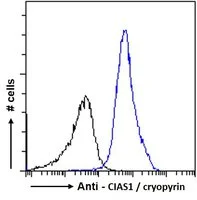
FACS analysis of PFA-fixed U937 cells using GTX89829 Cryopyrin ( C Terminus) antibody, C-term. Blue line : Primary antibody Black line : Negative control: Unimmunized goat IgG Permeabilization : 0.5% Triton Dilution : 10ug/ml
GTX89829 Image
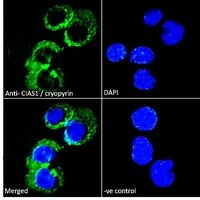
ICC/IF analysis of PFA-fixed U937 cells using GTX89829 Cryopyrin ( C Terminus) antibody, C-term. Green : Primary antibody Blue : DAPI Negative control: Unimmunized goat IgG (10ug/ml) Permeabilization : 0.15% Triton Dilution : 10ug/ml
GTX89829 Image
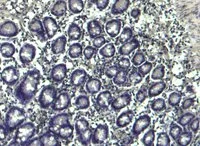
IHC-P analysis of human colon tissue without using GTX89829 Cryopyrin ( C Terminus) antibody, C-term.(Negative control)
GTX89829 Image
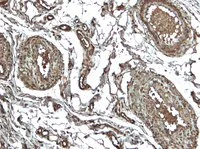
IHC-P analysis of human colon tissue using GTX89829 Cryopyrin ( C Terminus) antibody, C-term. Antigen retrieval : Citrate buffer pH 6.0 Dilution : 4µg/ml
| Manufacturer: | GeneTex |
| Preservative: | 0.02% Sodium azide|0.02% Sodium azide |
| Physical state: | Liquid |
| Type: | Polyclonal Primary Antibody - Unconjugated |
| Alias: | NLR family pyrin domain containing 3 , AGTAVPRL , AII , AVP , C1orf7 , CIAS1 , CLR1.1 , DFNA34 , FCAS , FCAS1 , FCU , KEFH , MWS , NALP3 , PYPAF1 |
| Shipping Condition: | Blue Ice |
| Unit(s): | 100 ug |
| Host name: | Goat |
| Clone: | |
| Isotype: | IgG |
| Immunogen: | Peptide with sequence C-EKPELTVVFEPSW, from the C Terminus of the protein sequence according to NP_001073289.1; NP_004886.3; NP_899632.1; NP_001120933.1; NP_001120934.1. |
| Application: | FC, ICC, IF, IHC-P |
Description
Description: This gene encodes a pyrin-like protein containing a pyrin domain, a nucleotide-binding site (NBS) domain, and a leucine-rich repeat (LRR) motif. This protein interacts with the apoptosis-associated speck-like protein PYCARD/ASC, which contains a caspase recruitment domain, and is a member of the NALP3 inflammasome complex. This complex functions as an upstream activator of NF-kappaB signaling, and it plays a role in the regulation of inflammation, the immune response, and apoptosis. Mutations in this gene are associated with familial cold autoinflammatory syndrome (FCAS), Muckle-Wells syndrome (MWS), chronic infantile neurological cutaneous and articular (CINCA) syndrome, and neonatal-onset multisystem inflammatory disease (NOMID). Multiple alternatively spliced transcript variants encoding distinct isoforms have been identified for this gene. Alternative 5' UTR structures are suggested by available data; however, insufficient evidence is available to determine if all of the represented 5' UTR splice patterns are biologically valid. [provided by RefSeq, Oct 2008]
Additional Text
Gene Name
NLRP3
Gene ID
114548
Uniprot ID
Q96P20
Concentration
0.5 mg/ml
Purification
Ammonium Sulfate Precipitated; Affinity Purified
Antibody Clonality
Polyclonal
Note
For In vitro laboratory use only. Not for any clinical, therapeutic, or diagnostic use in humans or animals. Not for animal or human consumption
Application Notes
ICC/IF: 10µg/ml. *Optimal dilutions/concentrations should be determined by the researcher.Not tested in other applications.
Storage Note
Store as concentrated solution. Centrifuge briefly prior to opening vial. For short-term storage (1-2 weeks), store at 4C. For long-term storage, aliquot and store at -20C or below. Avoid multiple freeze-thaw cycles.
 GTX89829 Datasheet
SUPPORT
outstanding technical support

PRODUCT
we offer a full product guarantee

DELIVERY
we offer free delivery to UK universities and non profit organisations